
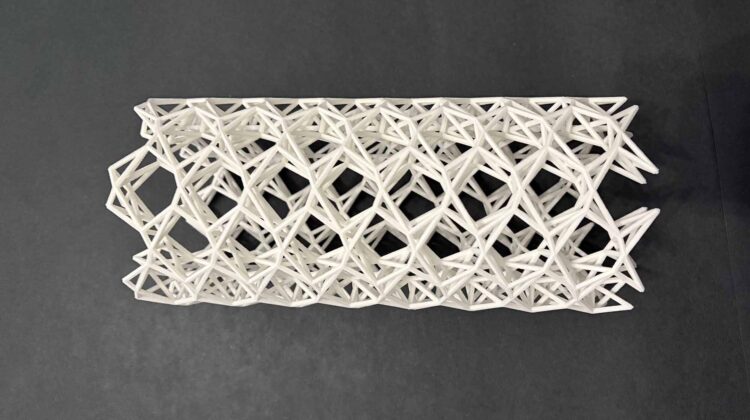
A team led by researchers at the University of Michigan and the Air Force Research Laboratory (AFRL) have shown how to 3D print intricate tubes that can use their complex structure to limit vibrations. Such structures could be useful in a variety of applications where people want to dampen vibrations, including transportation, civil engineering and more.
The team’s new study builds on decades of theoretical and computational research to create structures that passively impede vibrations trying to move from one end to the other. ‘That’s where the real novelty is. We have the realisation: we can actually make these things,’ said James McInerney, a research associate at the AFRL. ‘We’re optimistic these can be applied for good purposes. In this case, it’s vibration isolation.’
Advertisement

‘For centuries, humans have improved materials by altering their chemistry. Our work builds on the field of metamaterials, where it is geometry – rather than chemistry – that gives rise to unusual and useful properties,’ said Xiaoming Mao, a professor of physics. ‘These geometric principles can apply from the nanoscale to the macroscale, giving us extraordinary robustness.’
The new study is a melding of old-school structural engineering, relatively new physics and advanced fabrication technologies, like 3D printing, that are becoming increasingly impressive, McInerney said. ‘There’s a real probability that we’re going to be able to manufacture materials from the ground up with crazy precision,’ he said. ‘The vision is that we’re going to be able to create very specifically architectured materials and the question we’re asking is, “What can we do with that? How can we create new materials that are different from what we’re used to using?”’
Advertisement

As Mao said, though, the team isn’t tinkering with the chemistry or molecular composition of the materials. The researchers are investigating how they can use precise control of the shape of an arbitrary building material to elicit new and beneficial properties.
Human bones and plankton ‘shells,’ for example, take advantage of this strategy in nature. They’re built with complex geometries to get more than you might expect out of the substances they’re made from. With tools like 3D printing, researchers can now apply that strategy to metals, polymers and other materials to engineer sought-after properties that haven’t been attainable previously.
Advertisement
‘The idea isn’t that we’re going to replace steel and plastics, but use them more effectively,’ McInerney said.
While this work does rely on modern innovations, it has important historical underpinnings. For one, there’s the work of the famous 19th-century physicist, James Clerk Maxwell. Although he’s best known for his work in electromagnetism and thermodynamics, he also dabbled in mechanics and developed useful design considerations for creating stable structures with repeating subunits called Maxwell lattices, McInerney said.
Another key concept behind the new study emerged in the latter half of the 20th century, as physicists found that interesting and perplexing behaviours emerged near the edges and boundaries of materials. This led to a new field of study, known as topology, that’s still very active and working to explain these behaviours and to help capitalise on them in the real world.
Advertisement
‘About a decade ago, there was a seminal publication that found out that Maxwell lattices can exhibit a topological phase,’ McInerney said.
Over the last several years, McInerney and colleagues have explored the implications of that study as they pertain to vibration isolation. The team has built up a model explaining that behaviour and how to design a real object that would exhibit it. The team has now proved that its model is at its most advanced stage yet by actually making such objects with 3D-printed nylon.
Advertisement
A cursory look at the structures reveals why making them previously was such a challenge. They resemble a chain-link fence that’s been folded over and rolled up into a tube with a connected inner and outer layer. Physicists call these kagome tubes, a reference to traditional Japanese basket weaving that used similar patterns.
This is, however, just the first step in realising the potential of such structures, McInerney said. For instance, the study also showed that the better a structure is at suppressing vibrations, the less weight it can support. That is a costly, potentially even unacceptable, trade-off in terms of applications, but it highlights interesting opportunities and questions that remain at a fundamental level, he said.
As such novel structures are made, scientists and engineers are going to need to build new standards and approaches to test, characterise and assess them, which is a challenge that excites McInerney.
‘Because we have such new behaviours, we’re still uncovering not just the models, but the way that we would test them, the conclusions we would draw from the tests and how we would implement those conclusions into a design process,’ he said. ‘I think those are the questions that honestly need to be answered before we start answering questions about applications.’
The research has been published in Physical Review Applied.