
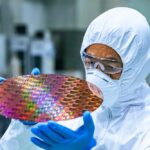
Before a computer chip reaches a phone, car or factory machine, engineers must work out how to make it reliably. NVIDIA has announced new software tools that use artificial intelligence and faster computer simulations to help with that process. Companies including Siemens, Synopsys, Cadence and Applied Materials are using NVIDIA’s technology to investigate materials, test … [Read more...] about NVIDIA expands AI tools to help engineers design and manufacture chips
Technology
3D-printed materials reveal damage before they fail
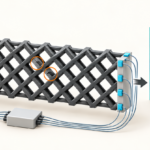
A crack can begin deep inside a component, out of sight long before the damage becomes obvious. Now, engineers at the universities of Glasgow and Sydney have borrowed a medical imaging technique to watch cracks develop inside 3D-printed materials, potentially giving future components a way to warn of approaching failure. The team printed plastic containing carbon nanotubes … [Read more...] about 3D-printed materials reveal damage before they fail
Could the soil beneath our feet behave like a computer?

Soil might look fairly inert, but beneath the surface it is constantly responding to water, temperature, nutrients and biological activity. Now Cambridge researchers are exploring a more unusual possibility: that soil itself could be treated as a kind of natural computer. Researchers at the University of Cambridge’s Bio-Inspired Robotics Laboratory are investigating soil as … [Read more...] about Could the soil beneath our feet behave like a computer?
Solar desalination system turns seawater into fresh water without brine waste

Researchers at the University of Rochester have developed a solar-powered desalination system that produces fresh water while recovering almost all of the dissolved salts as solids rather than generating concentrated liquid brine. The technology uses laser-treated black metal to absorb solar energy and move seawater across its surface, where it evaporates. The researchers … [Read more...] about Solar desalination system turns seawater into fresh water without brine waste
Light-steering chip redirects beams in just 74 femtoseconds

Researchers at Caltech have developed an ultrafast optical device capable of using one beam of light to redirect another in just 74 femtoseconds. The technology uses a nanoengineered silicon metasurface to amplify interactions between light and matter, potentially offering a new approach to controlling light in future communications, computing and sensing systems. At 74 … [Read more...] about Light-steering chip redirects beams in just 74 femtoseconds