
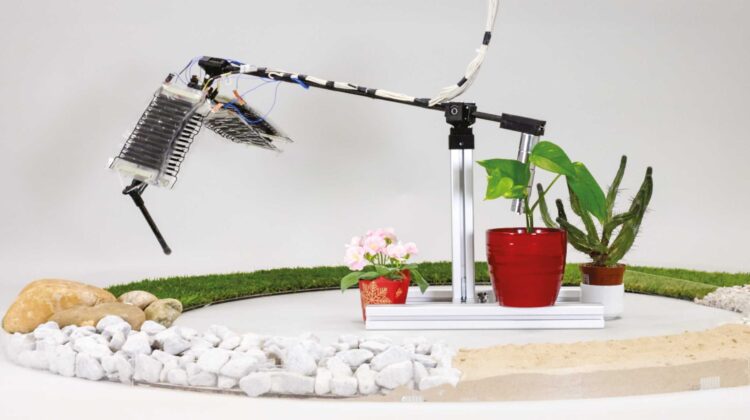
Researchers at ETH Zurich and the Max Planck Institute for Intelligent Systems (MPI-IS) have developed a new muscle-powered robotic leg that is not only more energy efficient than a conventional one, but can also perform high jumps and fast movements as well as detect and react to obstacles – all without the need for complex sensors.
Inventors and researchers have been developing robots for almost 70 years. To date, all the machines they have built have had one thing in common: they are powered by motors, a 200-year-old technology. Even walking robots feature arms and legs that are powered by motors, not by muscles as in humans and animals. This in part suggests why they lack the mobility and adaptability of living creatures.
Advertisement

As in humans and other animals, the new robotic leg features an extensor and a flexor muscle, which ensure that it can move in both directions. These electro-hydraulic actuators, which the researchers call HASELs, are attached to the leg’s skeleton by tendons.
The actuators are oil-filled plastic bags, similar to those used to make ice cubes. About half of each bag is coated on either side with a black electrode made of a conductive material. Doctoral student Thomas Buchner explained that ‘as soon as we apply a voltage to the electrodes, they are attracted to each other due to static electricity. Similarly, when I rub a balloon against my head, my hair sticks to the balloon due to the same static electricity.’ As the voltage is increased, the electrodes come closer and push the oil in the bag to one side, making the bag shorter overall.
Advertisement

Pairs of these actuators attached to a skeleton result in the same paired muscle movements as in living creatures: as one muscle shortens, its counterpart lengthens. The researchers use a computer code that communicates with high-voltage amplifiers to control which actuators contract, and which extend.

The researchers compared the energy efficiency of their robotic leg with that of a conventional robotic leg powered by an electric motor. Among other things, they analysed how much energy is unnecessarily converted into heat. ‘On the infrared image, it’s easy to see that the motorised leg consumes much more energy if, say, it has to hold a bent position,’ Buchner said.
Advertisement
The temperature in the electro-hydraulic leg, in contrast, remains the same. This is because the artificial muscle is electrostatic. ‘It’s like the example with the balloon and the hair, where the hair stays stuck to the balloon for quite a long time,’ Buchner added.
‘Typically, electric-motor-driven robots need heat management, which requires additional heat sinks or fans for diffusing the heat to the air. Our system doesn’t require them,’ said doctoral student Toshihiko Fukushima.
The robotic leg’s ability to jump is based on its ability to lift its own weight explosively. The researchers also showed that the robotic leg has a high degree of adaptability, which is particularly important for soft robotics. Only if the musculoskeletal system has sufficient elasticity can it adapt flexibly to the terrain in question. ‘It’s no different with living creatures. If we can’t bend our knees, for example, walking on an uneven surface becomes much more difficult,’ said Robert Katzschmann of ETH Zurich. ‘Just think of taking a step down from the pavement onto the road.’
Advertisement
In contrast to electric motors, which require sensors to constantly tell what angle the robotic leg is at, the artificial muscle adapts to a suitable position through the interaction with the environment. This is driven by just two input signals: one to bend the joint and one to extend it. ‘Adapting to the terrain is a key aspect,’ Fukushima explained. ‘When a person lands after jumping into the air, they don’t have to think in advance about whether they should bend their knees at a 90° or a 70° angle.’ The same principle applies to the robotic leg’s musculoskeletal system: upon landing, the leg joint adaptively moves into a suitable angle depending on whether the surface is hard or soft.
The research field of electrohydraulic actuators is still young, having emerged only around six years ago. ‘The field of robotics is making rapid progress with advanced controls and machine learning; in contrast, there has been much less progress with robotic hardware, which is equally important. This publication is a powerful reminder of how much potential for disruptive innovation comes from introducing new hardware concepts, like the use of artificial muscles,’ said Christoph Keplinger of MPI-IS.
Advertisement
Katzschmann added that electro-hydraulic actuators are unlikely to be used in heavy machinery on construction sites, but they do offer specific advantages over standard electric motors. This is particularly evident in applications such as grippers, where the movements have to be highly customised depending on whether the object being gripped is, for example, a ball, an egg or a tomato.
Katzschmann does have one reservation: ‘Compared to walking robots with electric motors, our system is still limited. The leg is currently attached to a rod, jumps in circles and can’t yet move freely.’ Future work should overcome these limitations, opening the door to developing real walking robots with artificial muscles. ‘If we combine the robotic leg in a quadruped robot or a humanoid robot with two legs, maybe one day, when it is battery-powered, we can deploy it as a rescue robot.’
The research has been published in Nature Communications.