
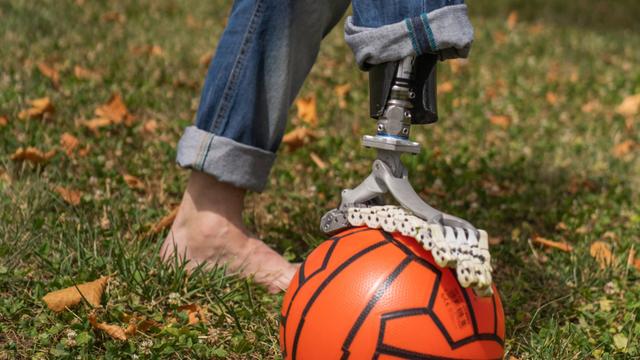
Engineers at the Istituto Italiano di Tecnologia (IIT) in Genoa have unveiled a unique motorless, flexible, waterproof prosthetic foot inspired by human anatomy. SoftFoot Pro is designed to be used on uneven terrain, including slippery ground, where it’s typically more challenging for prosthetic users, and for robots, to maintain balance.
‘What prostheses and today’s humanoid robots have in common is the characteristic of having flat or low-compliant feet, developed to ensure maximum stability but incapable of adapting to changes in terrain contour, slope and different positions, such as kneeling or bending,’ explained Manuel G Catalano, a researcher in the Soft Robotics for Human Cooperation and Rehabilitation Lab at IIT in Genoa.
Advertisement

Soft Foot Pro weighs about 450 grams and can support loads of up to 100 kilograms. It consists of a mobile arch mechanism made from titanium, whose ends are connected by five high-strength plastic chains arranged in parallel to simulate the plantar fascia of human feet. These chains are traversed lengthwise by a high-performance, mechanically inextensible 210-millimetre cable connected to the heel.
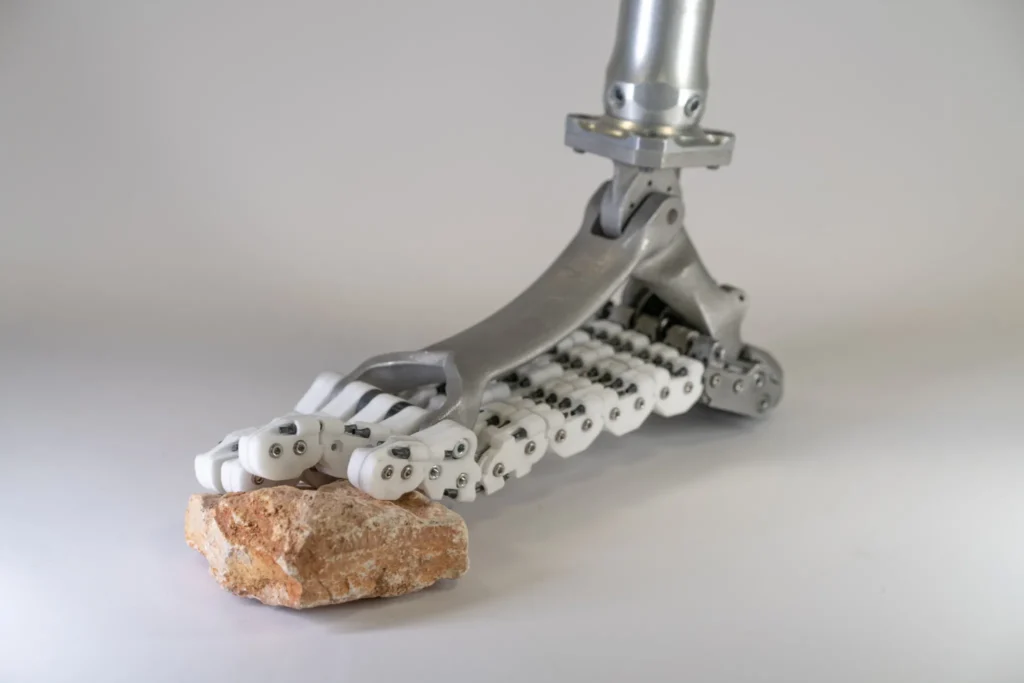
Each chain features multiple modules made of high-strength plastic derived from automotive technologies and linked to each other by paired elastic bands. The arch system and the elastic chains constitute the artificial equivalent of the architecture composed by tarsus, metatarsus and phalanges of the human foot.
Advertisement

This specific architecture allows the replication of the windlass mechanism, which progressively stiffens the plantar fascia to evenly distribute the force applied on the ground during walking. This aspect is crucial for the gait of those wearing SoftFoot Pro, as it allows the prosthetic foot to deal more efficiently with obstacles and, consequently, provides better forward propulsion during the step, together with better energy efficiency during the final phase of a step. At the same time, the adaptable and elastic feature of the sole helps with absorbing about ten to 50 per cent of the impact on the ground.
Moreover, in contrast to the current rigid prostheses on the market, SoftFoot Pro can change its shape, allowing the foot’s sole to deform and adapt to the roughness of the terrain and any obstacles, minimising their impact, improving the naturalness of the step and enhancing the stability of the user. In this sense, the prototype embodies a form of artificial intelligence, enhancing the system’s autonomy and management capabilities in harmony with the sensorimotor characteristics of the user.
Advertisement
Because of its flexibility, SoftFoot Pro perfectly reproduces the natural positions assumed by human feet and allows for performing simple everyday actions, such as bending down to tie a shoe, picking something up from the ground, climbing or descending stairs. Finally, as it’s waterproof, SoftFoot Pro can be used outdoors, avoiding the need for the user to switch to prostheses specifically designed for particular activities.
A number of SoftFoot Pro prototypes have been tested by individuals with unilateral lower limb amputations as part of international collaborations with Hannover Medical School and the Medical University of Vienna. It has also been also successfully tested with the quadruped robot Anymal at the Federal Institute of Technology Zurich and the humanoid robot HRP-4 at the University of Tokyo.