

ASM International, the world’s largest association of materials-centric engineers and scientists, has announced the winners of the 2025 DomesDay competition, held in Detroit, Michigan. Ten teams from seven universities designed and built a dome that was judged in various categories, the last of which saw each dome go up against the compression machine.
First place went to Aluminati from Missouri University of Science and Technology, while HammerDome from McMaster University were runners-up. Dome of Arc from Virginia Polytechnic Institute and State University won the award for materials innovativeness and Clutch’s Crown from Lehigh University won the Best Themed Design Award. And the Pitchforks, a team of first-year students from Arizona State University (ASU), won the Best-In-Destruction Award.
Advertisement

Established in 2014 by ASM student board members, DomesDay brings together teams from universities around the world to experiment, problem-solve and gain hands-on materials engineering experience by designing and testing small-scale geodesic domes.
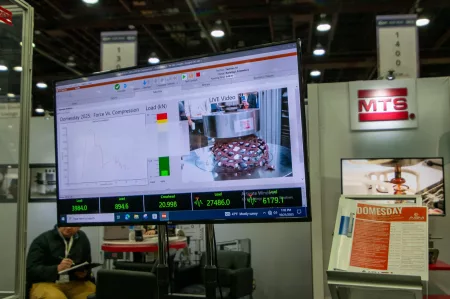
This year, ten teams from around the world were judged in various categories, all working toward a shared goal: creating a dome that blends structural performance, material innovation and creative design.
Advertisement

‘I hadn’t been to a national competition before,’ said Katelyn Flores, a materials science and engineering major who attended the competition. ‘As a first-year student, I was not confident competing against upper-class students.’
At ASU, the preparation for the competition began in FSE 101, a first-year course taught by Hamed Arami, an assistant professor of materials science and engineering in the School for Engineering of Matter, Transport and Energy. Arami divided the class of 40 students into ten groups and challenged them to create a dome.
Advertisement
The domes were tested under a compression machine, measuring the force at which the structure would fail. Based on their dome’s mechanical performance and strong collaboration, Arami selected two teams to represent ASU at DomesDay: Pitchforks and Devils Dome.
But the process wasn’t smooth sailing. Arami said that because each team was allowed to use any material of their choice to build their domes, the two best teams initially struggled to decide. ‘They had many options to choose from, including polymers and ceramics,’ Arami said. ‘In the end, both teams chose stainless steel.’
That choice introduced a new challenge: ASM had a weight limit of two kilograms. That was bad news for the Pitchforks team. Just a few weeks before the competition, their dome, while mechanically the strongest, exceeded the limit by a kilogram.
Advertisement
‘So, they had to rethink and redesign their dome,’ Arami said. ‘They found creative ways to decrease the diameter of the steel rods they were using and optimise the geometry of the dome. It slowed them down because they had to make new rods, but they eventually solved that problem. So, I encouraged them to register for DomesDay.’
While reimagining their design, instead of focusing on strength, the team optimised its dome to fail in a less destructive way than the competition. By welding stainless steel rods in a carefully considered geometry, the team engineered the geometrical structure of the dome so that the joints, which generally act as stress concentration points, would fail in a designed order that minimised destruction during collapse.
Advertisement
That approach mirrors the real-world considerations DomesDay is designed to explore. ‘How a building fails is very important,’ Arami said. ‘Whether it’s a full collapse or whether some parts break first can determine how many people die. Pitchforks members designed their dome with that understanding in mind.’
After a rigorous evaluation process, the team won the award for, as the certificate states, ‘the dome with the most spectacular failure’.
‘It was amazing to be able to represent ASU as a first-year student,’ Flores said. ‘I was surprised at how many opportunities there were to make connections with people who are well-established in materials science and engineering.
Arami said he’s proud of the Pitchforks and Devils Dome teams for their ability to work together to solve problems. ‘They were excellent team workers,’ he said.
He addes that one of the main objectives of the FSE 101 class is to teach students how to be creative, and for him, collaboration is the key. ‘Some students don’t like to talk. But after several weeks of working in groups, I see changes,’ Arami said. ‘The shy students start talking in class and expressing their opinions. I find that very interesting and important.’
The competition provided first-year students with the opportunity to design a solution under real constraints and trade-offs. While that’s important, Arami thinks they acquired something far more valuable. ‘They developed the confidence and belief in themselves that they can think creatively and do great things,’ he said. ‘Beyond design, software, or how to choose materials with higher mechanical properties, I wanted them to learn how to deal with each other’s different opinions and motivations to reach a goal. I’m happy to say that they achieved that.’
Flores said she’s proud of her team’s accomplishments at the competition. She added that the experience made her feel inspired to continue advancing and excelling in materials science and engineering. ‘The experience was inspiring,’ she said. ‘It was a great chance to make connections in the field and practice communication, leadership and collaboration skills. I’m looking forward to competing more.’