

A research team, affiliated with the Ulsan National Institute of Science and Technology (UNIST) in South Korea has unveiled a new technology that can convert seawater into clean drinking water using only sunlight, without any external power source. The breakthrough could play a crucial role in solving water shortages in developing countries and remote island communities, where electricity is often unavailable.
Led by Professor Ji-Hyun Jang from the School of Energy and Chemical Engineering at UNIST, the team announced the successful development of a ternary oxide-based evaporator capable of efficiently using solar energy to drive evaporation. When placed on seawater, the device heats the water, causing it to evaporate and then condense into fresh drinking water – all without needing electricity.
Their experiments showed that a one-square-metre setup can produce about 4.1 litres of clean water in just one hour. That’s nearly seven times the natural evaporation rate of seawater, making it the fastest oxide-based evaporator currently reported.
What makes this possible is a new kind of photothermal material – substances that absorb sunlight and convert it into heat. This material is coated onto the surface of the evaporator, enhancing its ability to turn sunlight into thermal energy.
Advertisement

The researchers achieved this by replacing parts of manganese in a corrosion-resistant manganese oxide with copper and chromium, creating a new ternary oxide. By carefully adjusting the material’s composition through a process called bandgap engineering, they made it capable of absorbing almost the entire solar spectrum – from ultraviolet to near-infrared light – covering 97.2 per cent of sunlight. Unlike typical oxide materials, which mainly absorb visible light, this new material captures and converts a much broader range of sunlight into heat.
The result is a surface temperature that can reach up to 80°C, significantly higher than previous manganese oxide-based materials, which topped out at around 63°C, or 74°C with copper-manganese oxides.
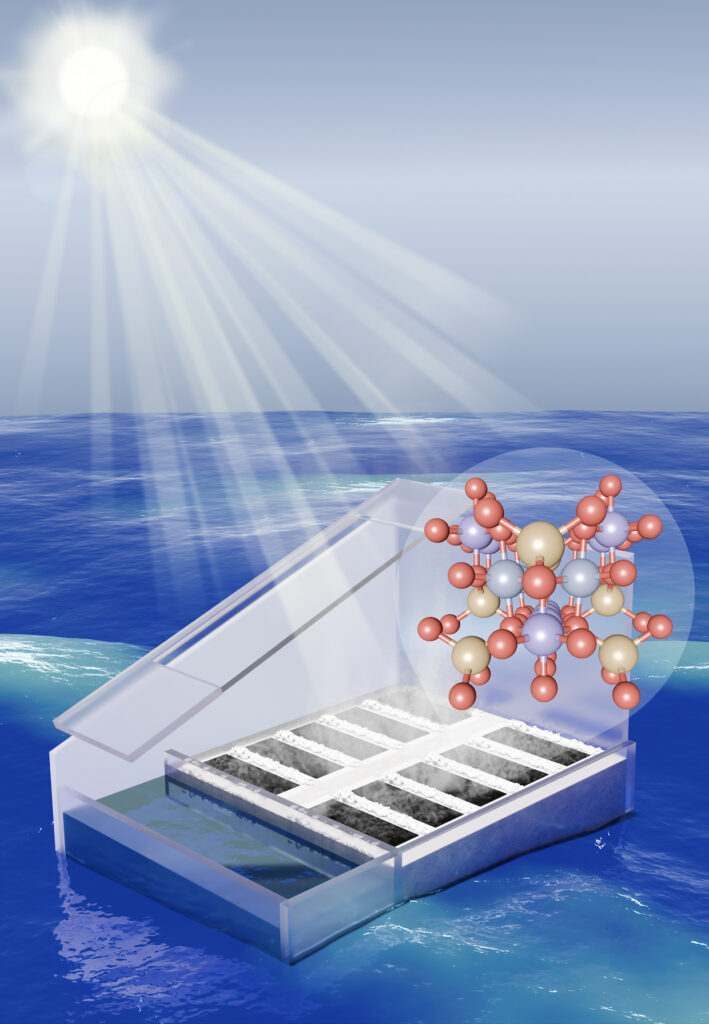
The device’s design also addresses a common challenge in solar desalination: salt buildup. It features an inverted U-shape, with the photothermal coating on the part that absorbs water. The structure includes water-wicking fibre materials and hydrophobic polyester fabric, which help draw water efficiently and allow salt ions to flow away, preventing salt accumulation on the surface.
‘We have fundamentally improved the light-absorption range and the photothermal efficiency of oxide materials, which allowed us to develop a high-performance, durable evaporator, Professor Jang. ‘Its scalability and stability mean it could be a practical solution to real-world water shortages.’
The research has been published in Advanced Materials.
Advertisement