
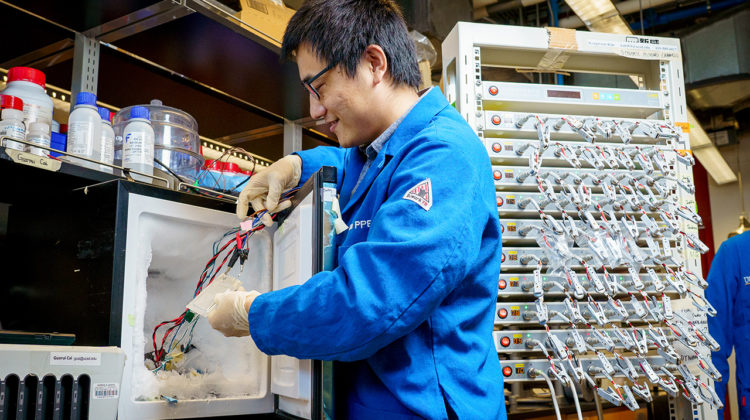
Engineers at the University of California San Diego have developed lithium-ion batteries that perform well at both freezing-cold and scorching-hot temperatures, while packing a considerable amount of energy.The researchers accomplished this feat by developing an electrolyte that is not only versatile and robust throughout a wide temperature range, but also compatible with a high-energy anode and cathode.
According to the researchers, the batteries could allow electric vehicles operating in cold climates to travel farther on a single charge while also reducing the need for cooling systems to keep the vehicles’ battery packs from overheating in hot climates.
Advertisement

‘You need high-temperature operation in areas where the ambient temperature can reach the triple digits [Fahrenheit] and the roads get even hotter. In electric vehicles, the battery packs are typically under the floor, close to these hot roads,’ said Zheng Chen, a professor of nanoengineering at the UC San Diego Jacobs School of Engineering. ‘Also, batteries warm up just from having a current run through during operation. If the batteries cannot tolerate this warm-up at high temperature, their performance will quickly degrade.’
The new batteries are both cold- and heat-tolerant thanks to their electrolyte, which is made of a liquid solution of dibutyl ether mixed with a lithium salt. Dibutyl ether molecules bind weakly to lithium ions, so they can easily let go of them as the battery runs. This weak molecular interaction, which the researchers discovered in a previous study, improves battery performance at sub-zero temperatures. Dibutyl ether can also easily cope with extreme heat because it stays liquid at high temperatures (its boiling point is 141°C).
Advertisement

The electrolyte is also compatible with a lithium-sulphur battery, a type of rechargeable battery that has an anode made of lithium metal and a cathode made of sulphur. Lithium-sulphur batteries are an essential part of next-generation battery technologies because they promise higher energy densities and lower costs. They can store up to two times more energy per kilogram than today’s lithium-ion batteries, which could double the range of electric vehicles without any increase in the weight of the battery pack. Also, sulphur is more abundant and less problematic to source than the cobalt used in traditional lithium-ion battery cathodes.
The problem with lithium-sulphur batteries is that both the cathode and anode are extremely reactive. Indeed, sulphur cathodes are so reactive that they dissolve during battery operation, an issue that worsens at high temperatures. Lithium-metal anodes are also prone to forming needle-like structures called dendrites that can pierce parts of the battery, causing it to short-circuit. As a result, lithium-sulphur batteries only last for up to tens of cycles.
Advertisement
‘If you want a battery with high energy density, you typically need to use very harsh, complicated chemistry,’ said Chen. ‘High energy means more reactions are happening, which means less stability, more degradation. Making a high-energy battery that is stable is a difficult task itself – trying to do this through a wide temperature range is even more challenging.’
The dibutyl ether electrolyte developed by the UC San Diego team prevents these issues, even at high and low temperatures. The batteries they tested had much longer cycling lives than a typical lithium-sulphur battery. ‘Our electrolyte helps improve both the cathode side and anode side while providing high conductivity and interfacial stability,’ said Chen.
In addition, by grafting the sulphur cathode to a polymer and thus preventing more sulphur from dissolving into the electrolyte, the team was able to make it more stable.
Advertisement
The team’s next steps include scaling up the battery chemistry, optimising it to work at even higher temperatures and further extending cycle life.
The research has been published in the Proceedings of the National Academy of Sciences.