
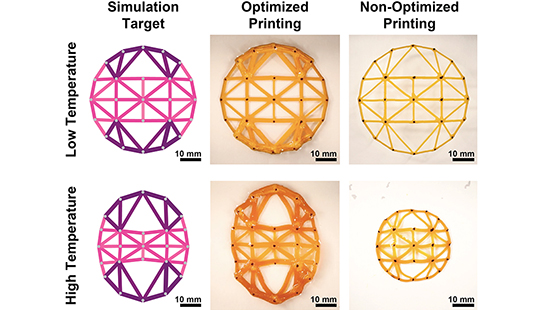
Researchers at Northwestern University in Illinois have used a combination of AI and 3D printing to develop materials that can reshape themselves in response to external factors, acting as if they have the built-in intelligence of living organisms.
The new method developed by Wei Chen, the Wilson-Cook professor in engineering design, and Ryan Truby, the June and Donald Brewer junior professor of materials science and engineering and mechanical engineering,can autonomously create material systems capable of changing shape when exposed to stimuli such as heat or light. This new materials engineering framework doesn’t just design the structure of materials, it also figures out the best material (stimuli) distribution and the printing process parameters necessary to achieve a desired shape in response to environmental cues, all without human input.
This new approach to engineering shape-morphing, stimuli-responsive materials integrates two computational techniques – generalised topology optimisation with hybrid data-physics differentiable simulations – that enable the efficient design of complex systems. The approach accelerates high-dimensional design exploration and unlocks the full potential of advanced manufacturing. The system also quickly adapts to changing design requirements, rapidly producing new designs in just minutes.
For a desired shape-morphing task, the team’s method automatically designs the materials and structure in just one minute, complete with all instructions for how they should be 3D printed. Fittingly, the produced designs have structures and shape-changing behaviours that often resemble biological systems, patterns that emerge naturally from the optimisation process. This suggests that the method not only improves performance but also uncovers new design principles that mirror nature.
Advertisement

‘By combining AI, physics and digital manufacturing, we’ve created a powerful tool for developing adaptive materials that could be used in medical devices, robotics and other technologies that need to respond to changing environments or functional needs,’ Chen said. ‘It’s a step toward smarter, more versatile materials that can do things traditional systems simply can’t.’

Recent advances allow materials to respond to multiple stimuli, but current design methods are limited to single responses and rely heavily on trial-and-error or expert intuition, restricting creativity and performance. Designing and manufacturing multi-responsive materials remains a significant challenge.
The team overcomes this by creating a system that automatically designs and fabricates materials to change shape in programmed ways under multiple triggers. This approach is generalisable, extending to other manufacturing methods and responsive materials.
‘This breakthrough helps close the gap between what stimuli-responsive materials we can design and how we actually build and manufacture them for practical engineering applications,’ Truby said.
Working alongside Wang’s computational efforts, Alex Evenchik, a PhD candidate in the Robotic Matter Lab, developed new inks and 3D-printing processes to fabricate stimuli-responsive materials called liquid crystal elastomers, building on prior work from Truby’s lab.
Advertisement
‘Next steps include linking shape changes to specific applications. Can we leverage this system to design new, unintuitive ways to create artificial muscles, mechanical computers, or drug delivery devices? Now that we’ve demonstrated that our approach works, I hope we can begin to apply it to address key societal challenges that traditional engineering materials can’t solve,’ Evenchik said.
‘We also see a synergy between nature and AI, where AI optimises materials like evolution, and materials act like computer programs. We’re excited to study this synergy from both directions –for example, comparing the network topologies that emerged in design with those found in nature,’ said Liwei Wang, a former postdoctoral scholar in the Integrated Design Automation Laboratory and now assistant professor at Carnegie Mellon University. ‘These directions will help deepen our understanding of programmable materials and expand their practical impact.’
The research has been published in Science Advances.