
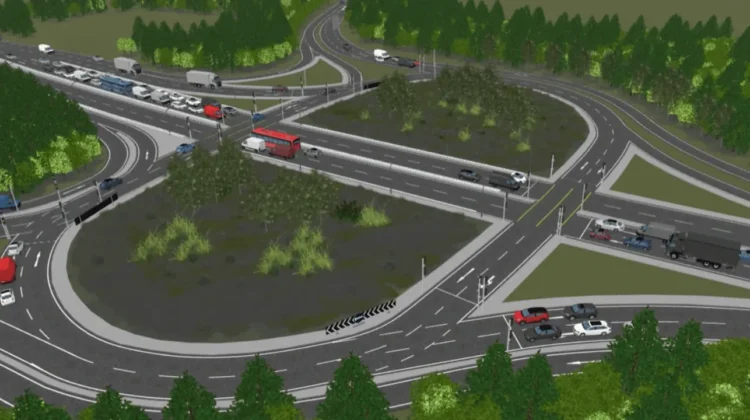
Students investigating one of Scotland’s most congested road junctions have developed an innovative conceptual redesign. The idea explores how a minimum-interruption approach, based on alternative junction layouts, could significantly improve traffic flow and environmental performance while avoiding the scale of disruption often associated with major infrastructure interventions.
Plagued by daily tailbacks and with upgrade proposals delayed for almost a decade, the Sheriffhall Roundabout on the southeast edge of Edinburgh has become a major frustration for motorists. Civil engineering students from Heriot-Watt University have proposed a conceptual alternative design developed as part of their final-year studies.
Among the design elements considered, students examined the potential of a ‘throughabout’ – a junction layout that allows some bypass traffic to pass through the centre rather than circulating around the roundabout.
‘Civil engineering is a complex and wide-ranging discipline, and throughout their studies, students naturally develop interests across many different areas,’ said Associate Professor Shadi Mohamed from the School of Energy, Geoscience, Infrastructure and Society. ‘When designing this course, our intention was to unlock the full creativity of the students while ensuring their work remained grounded in real-world civil engineering practice. No single department can cover every dimension of civil engineering or fully replicate the breadth of industrial experience, so we established an industrial panel to support students throughout their journey.
Advertisement

‘The panel represents key sectors across the profession, including public bodies, infrastructure consultants, utilities, project management specialists and contractors,’ she continued. ‘It has been involved from the earliest stages, helping students define project briefs aligned with their interests, and supporting them as they developed complete, real-world solutions. Importantly, students did not stop at conceptual ideas. They developed full technical solutions, shaped through engagement with relevant stakeholders and grounded in real-world feasibility. They ran detailed traffic simulations under higher-than-current forecast demand, tested their design against modern highway standards, and worked through everything from foundation engineering to sustainable drainage and carbon reduction, achieving a 12 per cent saving in embodied carbon through careful material choices and local sourcing.’
Among their sustainability commitments, the students selected a low-carbon concrete produced just ten minutes from the site, cutting the material’s carbon footprint by 50 per cent. Elsewhere in the design, recycled plastic and reclaimed aggregate were used in place of traditional materials, reducing emissions without compromising performance.
With the junction expected to carry up to 80,000 vehicles a day, managing polluted surface water run-off was a major challenge. The students responded by designing a new wetland and pond system around the Dean Burn, a waterway that runs directly through the site and feeds into a river already classed as being in poor environmental condition. Rather than simply containing run-off, the system is designed to filter and treat water before it reaches the burn, while also creating new habitat and providing flood storage for the surrounding area.
The students surveyed more than 400 residents and commuters, finding that 65 per cent of respondents reported difficulty gaining access to key services such as healthcare and employment.
‘What the throughabout allows for is an increase in traffic flow by letting the main traffic on the bypass pass straight through the middle of the junction rather than having to stop and go round,’ said Tom Aitchison, a Meng Civil Engineering student. ‘Similar junction layouts have been trialled elsewhere in the UK, which helped inform our thinking as we explored how different design approaches could work in a Scottish context.
Advertisement
‘What inspired us was hearing from the people who use this road every day’ he continued. ‘It was very evident from the start that the roundabout experienced high congestion levels, but we didn’t expect people to feel quite so passionately about it. The responses gave us a lot to work with and made sure we kept the real-world impact of our work front and centre throughout.’
The work was evaluated by Transport Scotland through the course assessment process and received top scores across all assessment criteria.
‘This project is a strong example of the kind of work our students get to sink their teeth into at Heriot-Watt, tackling live problems with real-world relevance and outcomes that matter beyond the lecture theatre,’ said associate professor Rod Macdonald OBE. ‘Across the University, students regularly work on challenges that connect directly with the communities around them, and that experience of applying their skills to something tangible is invaluable. Our hope is that the insights from this project can play a constructive role in informing future conversations about Sheriffhall.’