

Researchers at Chalmers University of Technology in Gothenburg, Sweden, have developed a new, entirely bio-based material from yeast. The material is 3D-printed and customised for use in architectural and interior design elements that are currently made from non-renewable or fossil-based materials such as plaster, plastic or synthetic textiles.
The construction sector accounts for a large proportion of global emissions and resource consumption, which means that there’s a great need for renewable, resource-efficient alternatives. The research team from Chalmers investigated how industrial residual products can be used to create new materials that can contribute to greater circularity in architecture and the built environment.
The newly developed material consists of baker’s yeast, cellulose fibres from wood, alginate from algae, glycerol from plants and water. Together, the ingredients form a kind of hydrogel – a soft, jelly-like, malleable material – that can be 3D-printed.
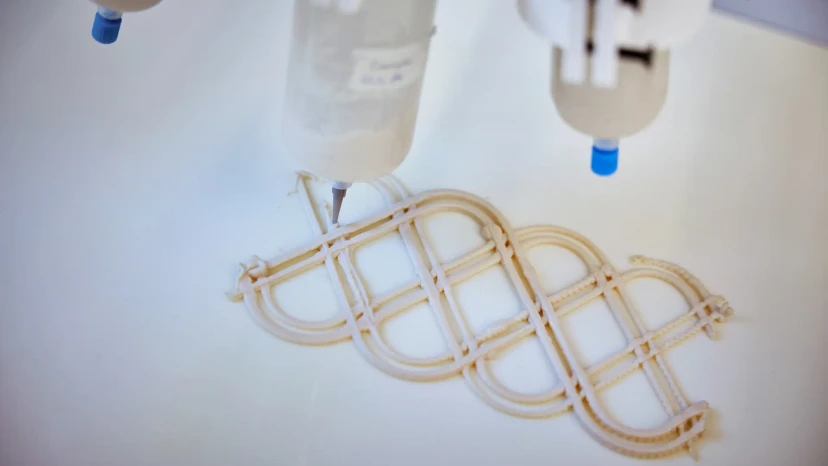
‘I’ve always been interested in the combination of architecture and living materials, and essentially this research is about creating an architectural material made entirely from organic, renewable ingredients,’ said Malgorzata Zboinska, a professor at the Department of Architecture and Civil Engineering at Chalmers. ‘By combining biomaterials with digital manufacturing, we can take a novel approach to both the design and production of architectural components.’
Advertisement

The project combines design, materials innovation and advanced manufacturing technology. The first part of the process is similar to baking, but in slightly reverse order. First, the yeast is heated to deactivate it, and then the various ingredients are mixed together to form a smooth mass. The architectural elements can then be manufactured using pressure-based 3D printing, which is carried out at room temperature. This requires neither energy-intensive heating nor additional support structures.
‘3D printing makes it possible to create complex shapes without producing waste,’ said doctoral student Yagmur Bektas. ‘We can design and manufacture the material directly – with a high degree of control over its shape, texture and material distribution.’
With minor adjustments to the formula, the material’s transparency, colour and surface texture can be altered, making it well suited for interior applications such as daylight modulating and sunlight protecting screens, wall panels or room partitions. In the long term, the yeast material could also become an environmentally friendly alternative to plastics and other petroleum-based products, such as synthetic textiles.
Depending on the composition of the formula, the material takes on a natural hue that ranges from yellow to brown tones. The colour can be altered using natural pigments or pigment-producing yeast strains. It’s also possible to design different patterns, vary the transparency of the material and how it feels.

The use of yeast as a material component hasn’t yet been explored in architecture. ‘Yeast grows exponentially,’ said Zboinska. ‘It doesn’t require strictly controlled environments and is not particularly sensitive to contamination. Because it consists of single-celled organisms, we can produce a more homogeneous, predictable material.’
Advertisement
What makes the researchers’ new formula unique is that the yeast isn’t used in the usual way for fermentation, but acts as biomass. It then becomes a robust component that gives the material its volume, stability and strength.
Zboinska also highlighted the potential of using by-products from industries such as brewing and agriculture, as some of these products are often discarded. Residue that can’t be used as food or animal feed could therefore be used in architecture.
Unlike traditional building materials, which are designed to last as long as possible, bio-based materials offer new ways of thinking about sustainability and material cycles. The yeast-based material is biodegradable and can return to nature after use – a key aspect of circular design. ‘This challenges the traditional notion that materials must last forever, or at least have as long a physical life cycle as possible,’ said Zboinska. ‘Instead, we can think in terms of shorter life cycles and even view the ageing or degradation of the material as part of the design.’
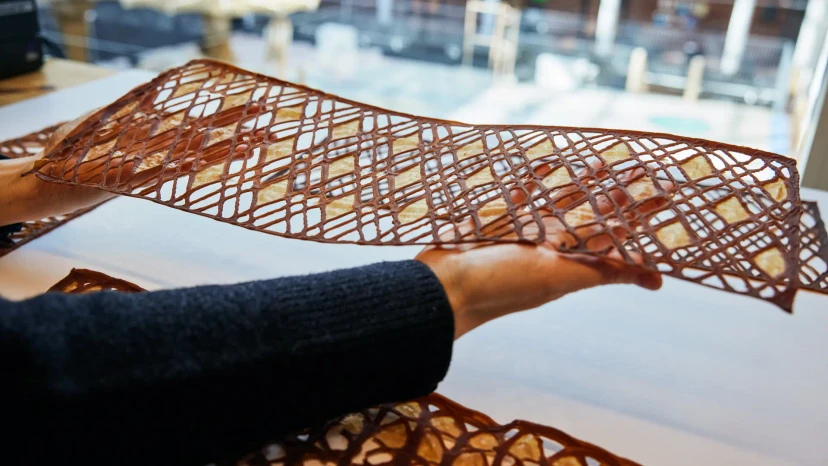
Although the results show great potential, further research is needed before the material can be used widely in buildings. Future studies will assess key properties such as strength, fire safety and moisture performance, as well as scaling up digital manufacturing and developing stronger and more robust structures.
‘The future of architectural ELMs, or Engineered Living Materials, is very exciting, with great potential to customise them to perform a variety of functions,’ said Zboinska. ‘This could, for example, involve self-healing materials or materials that purify the air by neutralising harmful substances and pollutants. What we have achieved so far is an important first step towards establishing a completely new type of architectural material. You could say that we are laying the foundations for future developments that combine sustainability, functionality and design in entirely new ways.’
The research has been published in Frontiers of Architectural Research.