
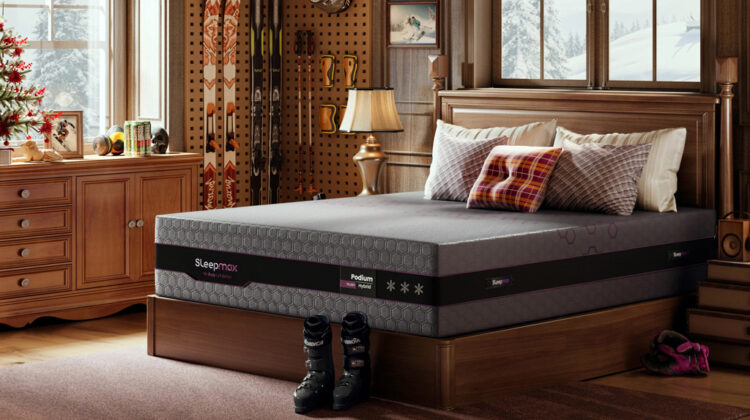
US mattress company Sleepmax has come up with a new design that moves away from traditional ‘one-size-fits-all’ ergonomics toward more inclusive engineering.
A newcomer positioned in the mid-to-high-end segment, Sleepmax, has attracted attention for challenging the dominant paradigm of ‘zoned’ ergonomics. The company recently introduced two new ergonomics-driven mattress models built on its hexagonal spring matrix system. The products are slated to make their first public appearance at the Las Vegas furniture and bedding exhibition in January 2026, with online sales expected to begin ahead of the event in December.
For nearly two decades, the mainstream ergonomics model in mattress design has been built around zoning – typically three-zone or five-zone layouts that assign different firmness levels to the head, lumbar region and legs. The method is straightforward: in practice, manufacturers typically soften the head zone and reinforce the lumbar zone to create a sense of targeted support. To achieve this, they may vary the firmness of the memory foam across different sections of the comfort layer, or adjust the spring gauge in corresponding regions.
Yet researchers and designers have increasingly pointed out a foundational flaw: whose body are these zones based on?
Advertisement

Anthropometry studies show that men and women of the same height often exhibit significantly different spinal curvature, pelvic tilt and lumbar positioning. Differences widen even further across height, weight and body composition groups. However, much of the historical ergonomic testing in consumer products, including bedding, has been anchored to a narrow sample range.
This bias isn’t unique to mattresses. Caroline Criado Perez, in her award-winning book Invisible Women, argues that many modern products are still built upon a long-standing assumption: ‘male by default, unless otherwise stated’. She describes it not as malice, nor conscious exclusion, but as a deeply ingrained design habit shaped over centuries – the belief that the average male body can stand in for all bodies.
Against this backdrop, Sleepmax has taken a different engineering route. Rather than segmenting the mattress into fixed zones, the company developed a hexagonal spring matrix intended to offer a more adaptive response to varied body shapes.
The spring system is composed of hundreds of micro-modules, each structured as a six-sided cell containing seven individually pocketed springs. The vertices of each hexagon use thicker-gauge springs to form micro-support nodes. According to the design team, this configuration distributes load across a wider surface area, lowering localised pressure and reducing strain on the shoulders, hips and lower back.
Unlike zoning, the matrix doesn’t determine firmness based on pre-assigned human averages. Instead, each cell responds independently to downward force. The company’s engineers say that this allows the mattress to better adjust to the contours of bodies that deviate from standardised anthropometric test profiles – a category that includes the majority of real-world users.
Advertisement
Early mechanical testing suggests that the multi-point structure yields more uniform pressure maps and smoother gradient transitions between high-load and low-load regions. Industry analysts believe such designs may represent the next phase of ergonomics evolution, especially as consumer expectations shift toward personalisation and inclusivity.
The renewed focus on diversity in human models aligns with broader cross-industry trends. Over the past five years, several sector – sportswear, automotive, medical devices – have been re-examining long-standing engineering assumptions built around narrow datasets.
In sleep science, the conversation is accelerating. Analysts point out that as sleep becomes a US$500billion-plus global industry, brands are under pressure to address not only comfort but the biomechanics underlying spinal alignment and recovery. That includes reassessing how ‘ergonomics’ is defined and who it’s defined for.
Sleepmax’s approach, still relatively new in the mass mattress market, has received attention precisely because it challenges the dominant zoning model. Industry observers note that whether or not hexagonal matrix systems become mainstream, the shift signals an important inflection point: the recognition that ergonomics must evolve beyond averages.
As global discussions around inclusive design continue to expand, more companies may follow in rethinking how human diversity is represented in product development. For the mattress category – long reliant on fixed zones and uniform assumptions – this could mark the beginning of a structural redesign.
Sleepmax, for its part, positions its hexagonal matrix as ‘a step toward a more adaptive, data-driven approach to sleep support’. And while the industry continues to debate the future of ergonomic standards, one idea is gaining consensus: the human body is far too varied to be defined by a single template.