

Using origami folding techniques as inspiration, researchers in the Department of Aerospace Engineering in the Grainger College of Engineering at the University of Illinois Urbana-Champaign have developed several design concepts for flexible, lightweight waveguides that can be launched in a compact, folded state, then expanded to full size after being deployed into space.
Electromagnetic waveguides are used by high-powered satellites to deliver energy from one component to another. They are typically made of heavy, inflexible metal tubes with an even heavier flange on either end, neither of which is ideal for space applications.
Advertisement

‘My former colleague at Penn State, Sven Bilén, is an expert in electromagnetics. I showed him some origami structures I’d been working on a few years ago. He was intrigued and asked if origami could be used for deployable electromagnetic waveguides. We started exploring this idea since then,’ said Professor Xin Ning. ‘Because the most common electromagnetic waveguides are rectangular, our origami designs needed to maintain a rectangular cross section in the operational state for comparable performance.’
Ning said the simplest rectangular foldable structure he could think of was a brown paper shopping bag. The rectangular bottom portion acts like the flange. Graduate students Nikhil Ashok and Sangwoo Suk created a design with two shopping-bag-like sections to obtain a foldable tube and rectangular inlet and outlet for connection to flanges. Using that as a starting point, they developed more advanced origami electromagnetic waveguides shaped like a bellows. Ning said the folding is time consuming, but by the end, both students had mastered the skill.
Advertisement

To fabricate the model, the pattern was printed onto large paper, then laminated with kitchen aluminium foil and folded. For use in spacecraft, Ning said they might be 3D-printed durable materials, then coated with more durable high-quality commercial materials such as Kapton and metal laminates.
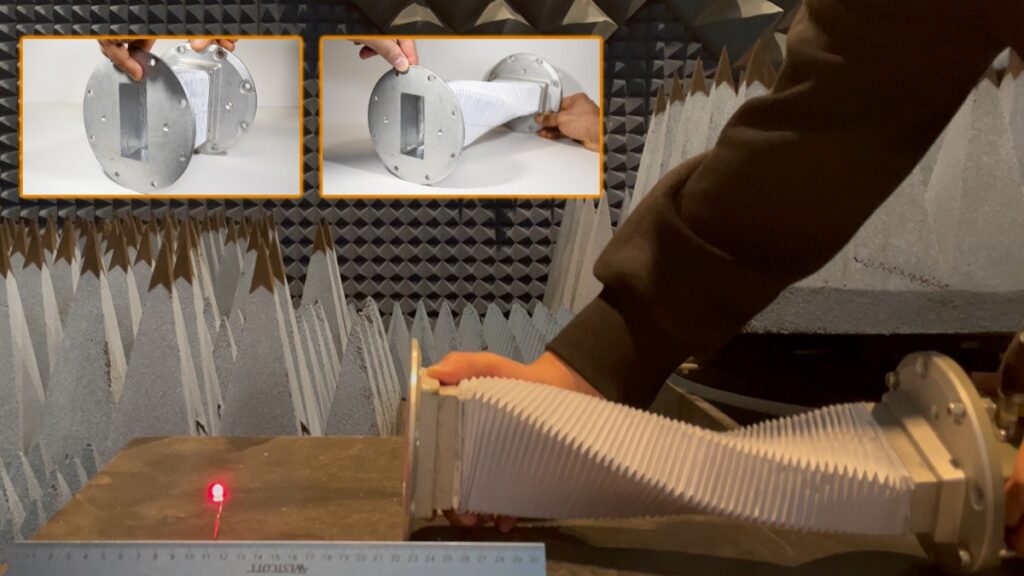
He said they didn’t choose random cross sections or lengths. Instead, they modelled their structures based on commercial designs so they could compare apples to apples.
Advertisement
‘With the first bellows shape, we knew we had a foldable, deployable design that could perform, but we wanted to explore more possibilities with origami principles,’ Ning said. ‘We needed to find other designs that could twist and bend as it unfurls at the right angle and the right distance between the flanges. These new designs were more complicated, so we simulated the model to try different distances and angles and achieve a 90° twist from the input to the output.’
Ning said everything began experimentally before moving to analytical design models. While testing the twisting, bending model, they ran into a snag. ‘After a few inches of easy deployment, it suddenly got stuck and we really wanted to understand why. We spent a lot of time trying to understand the mechanics and analysing the angle and distance and deriving the equations. We saw that when we stretched the model, the load was initially very low, then it would shoot up. We realised that when it is stretched to the point where the creases are flat, the force could break it.’
Ning said adding more folds to achieve a longer waveguide made it more difficult and longer waveguides would result in more energy loss. ‘We finally arrived at the maximum distance we want to carry and designed it to reach that point with just enough units, or folds.’
Advertisement
The team now has a pending patent. And although the researchers’ design focus was initially for spacecraft, the concept can be applied for waveguides used in naval, electrical and communications systems for transferring microwave energy.
The research has been published in Communications Engineering.
Advertisement