
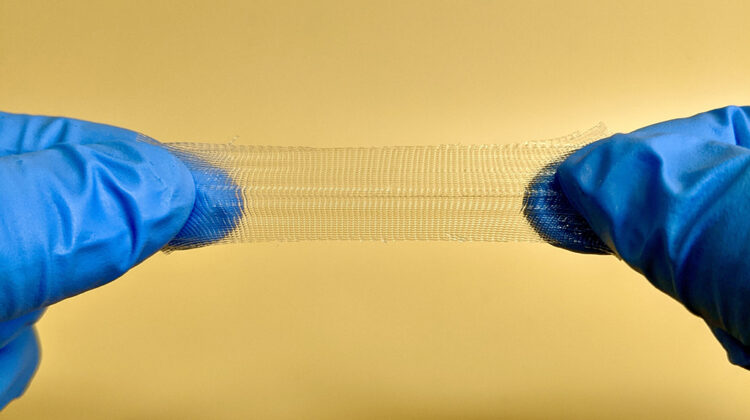
A team of MIT researchers has developed a direct-ink-write 3D-printable tissue adhesive that can be used to fabricate customised bio-adhesive patches and devices.
Tissue sealants and adhesives offer an attractive alternative to sutures or staples for closing wounds or incisions. These materials offer numerous advantages, particularly for minimally invasive procedures, in that they are easy to use, quick to apply and cause less damage to surrounding tissue – but most existing options suffer from weak adhesion or poor biocompatibility.
Advertisement

‘There has been a lot of progress recently in the field of bio-adhesives, but traditionally, these materials have been confined to a “one-size-fits-all” paradigm – meaning they feature a fixed set of properties and form factor, limiting their versatility across various clinical needs,’ said Sarah Wu, a graduate student who works in the lab of mechanical engineering professor Xuanhe Zhao. ‘Our research takes a departure from this approach, offering a way to customise bio-adhesive patches or devices to adapt to diverse applications.’
3D printing has emerged as a key technology for manufacturing biomedical products such as prosthetics, pharmaceuticals and reconstructive tissues, but until now, there has been limited exploration of 3D printing tissue adhesives.
Advertisement

The new 3D-printable tissue adhesive can be used to fabricate bio-adhesive patches and devices with programmable architectures, unlocking new potential for application-specific designs. The researchers used a technique called direct ink writing, which deposits materials in layers to create 3D structures. The technique allows for embedded circuitry or sensors, and permits rapid manufacturing techniques. In this new work, the researchers demonstrate how 3D printing can be used to create patches with tissue-specific mechanical behaviour.
Wu said the new study is one of the first reports of a bio-adhesive that can be used for more complex design and manufacturing. ‘We demonstrate how 3D printing can be used to create patches with programmable mechanical behaviour, as well as tissue-interfacing devices such as bioelectronic or drug-delivery patches,’ she says.
Advertisement
The new printable adhesive is conformable, stretchy and quickly achieves robust adhesion with wet tissue. Further, the incorporation of a blood-repelling hydrophobic matrix enables the printed patches to seal actively bleeding tissues. Beyond wound closure, the 3D-printable adhesive has broad applicability across various tissue-interfacing devices and it exhibits favourable biocompatibility.
‘In testing, the material demonstrated efficacy in repairing defects in the airway, colon, liver and artery of animals, even with active bleeding present,’ said Wu. ‘Beyond tissue sealing, it could serve as a robust interface between humans and devices. Overall, we believe a 3D-printable tissue adhesive could open a wide design space in the manufacturing of more complex tissue adhesive technologies.’
Models presented in the recent work demonstrate the fluid-tight tissue-sealing capability of the printed patches, which maintained adhesion for more than four weeks. According to the researchers, the platform offers a promising strategy towards developing advanced tissue-adhesive technologies.
Advertisement
The research has been published in Nature Communications.