
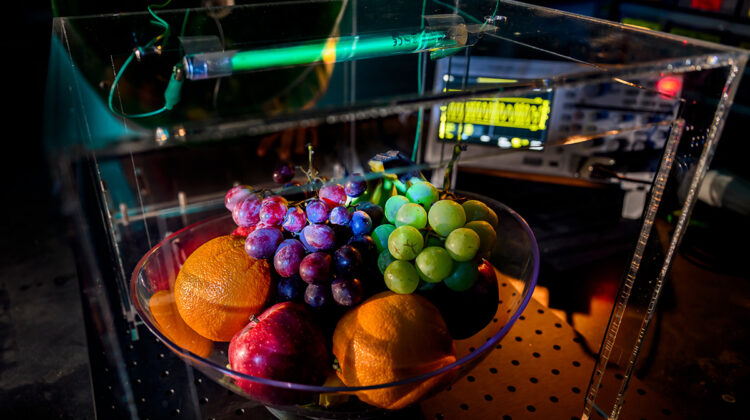
Scientists at the University of Illinois Urbana-Champaign have developed a portable, self-powered ultraviolet-C device that can inactivate two of the bacteria responsible for many foodborne illnesses and deaths.
Dubbed the Tribo-sanitizer, the device’s UVC lamp is powered using the triboelectric effect – electricity that’s generated when two dissimilar materials come into contact. In tests, the Tribo-sanitizer successfully inactivated two potentially deadly foodborne bacteria, Escherichia coli O157:H7 and Listeria monocytogenes, mainly by damaging their DNA.
The bacteria selected as testing targets are two of the most common causes of serious foodborne illness outbreaks in the USE. E. coli produces toxins that can cause severe abdominal cramps, fever, bloody diarrhoea and kidney failure, and L. monocytogenes can cause listeriosis, which has the highest rates of hospitalisation and mortality of any foodborne illness.
The team assessed the Tribo-sanitizer’s decontamination capability with bacteria in liquids and on three solids – fresh apple peels, romaine lettuce and polyethylene terephthalate, commonly known as PET, a popular material for food and beverage packaging.
Advertisement

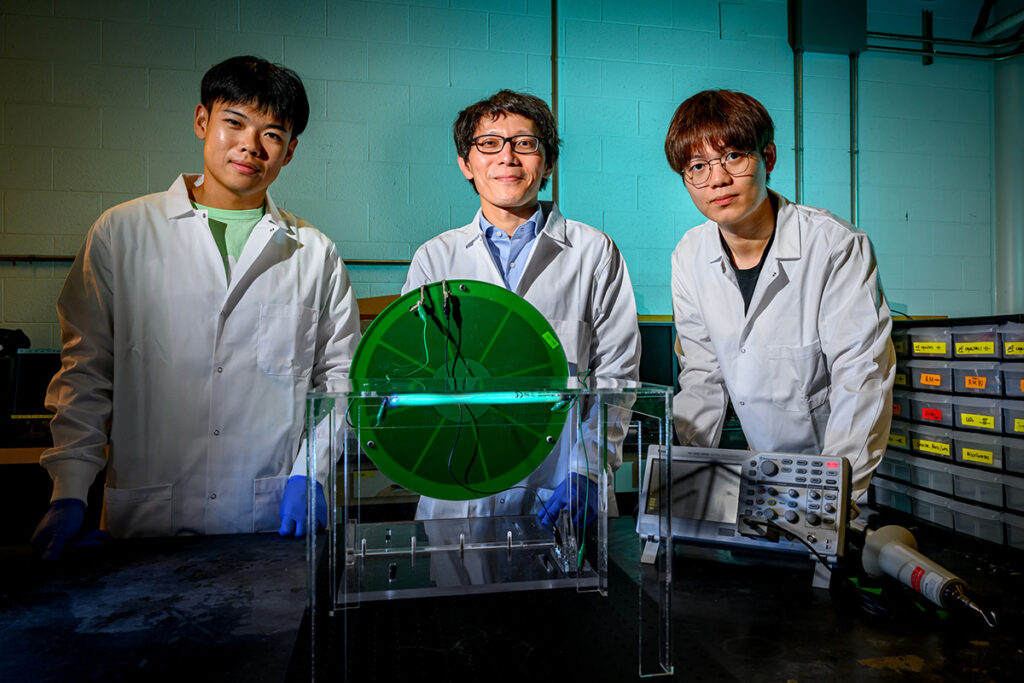
The results indicated that the Tribo-sanitizer had strong potential to meet the Food and Drug Administration’s sanitisation standards. Specifically, the device ‘achieved reductions of at least 99.999 per cent on the E. coli strain in buffer solution and on PET, demonstrating the Tribo-sanitizer’s excellent decontamination ability,’ said Yi-Cheng Wang, a professor of food safety and engineering (pictured below, at centre).
On produce, the device achieved smaller but still useful reductions of about 99.98 per cent for the E. coli bacteria and 99.9 per cent for L. monocytogenes on the apple peels, and 99.8 per cent for E. coli and 98 per cent for L. monocytogenes on romaine lettuce.
These outcomes ‘are comparable to those reported in other studies that utilised UV light with a commercial power source for the decontamination of fresh produce’, said doctoral student Zachary (Zhenhui) Jin (pictured below, at left).
The Tribo-sanitizer’s triboelectric power source can convert mechanical energy from the ambient environment – for instance, from human motions and wind – which is why the research team describes it as ‘self-powered’, Wang said.
An air gap that the team incorporated into the design of their triboelectric power source mimics lightning by electrostatically breaking down air. This innovation increased Tribo-sanitizer’s output to more than 4,000 volts and markedly increased the brightness of its UVC lamp, according to the study.
Advertisement
While light-based technologies like Tribo-sanitizer’s lamp ‘can be very effective when surfaces are directly exposed to the light source’, Wang said, they may not adequately decontaminate areas that aren’t directly illuminated, such as uneven or rough surfaces on lettuces and apple peels.
‘This could be addressed by incorporating other decontamination methods or using multiple light sources at different angles,’ he said. ‘That is one of the future directions we are working on. And if properly incorporated into existing facilities such as transportation or storage units, the Tribo-sanitizer could potentially provide continuous decontamination throughout the supply chain without the need for commercial power.’
Although the length of time needed to achieve a 99.999 per cent reduction in E. coli bacteria was long – currently 90 minutes – Jin said that the device’s potential to achieve continuous decontamination, such as within trucks on the highway, means that this extended time shouldn’t be seen as a major drawback. The team is continuing its efforts to improve the Tribo-sanitizer, and ‘this time can be expected to be much shorter in the future’, he said.
According to the World Health Organization, foodborne illness affects almost 600 million people annually, resulting in 420,000 deaths. The economic cost of dealing with the consequences of food contamination is more than US$15.6billion per year in the USA and US$110billion in low- and middle-income countries, according to estimates by the US Department of Agriculture and the WHO, respectively. Wang said that the Tribo-sanitizer represents a novel means of alleviating these problems.
Consumers could use Tribo-sanitizers at home to sanitise surfaces, foods and more because ‘the estimated cost of the materials used to build the device is less than US$70’, Jin said.
The device’s self-powered character also gives it ‘excellent potential for use in low-resource settings such as natural-disaster areas and conflict zones where electricity is absent or unreliable’, graduate student Longwen Li (pictured above, at right) said.
Along with mitigating food-safety problems, these devices could also be useful in addressing public health problems, such as preparing for and responding to new pandemics, Wang said.
The research has been published in Nano Energy.