
Researchers from the University of Texas at Austin, Shanghai Jiao Tong University, the National University of Singapore and Umea University in Sweden have used machine learning and artificial intelligence to develop new materials known as thermal meta-emitters that could, among other things, keep houses cooler and reduce energy bills.
The researchers developed more than 1,500 different materials that can selectively emit heat at various levels and in different manners, making them ideal for energy efficiency through more precise cooling and heating.
‘Our machine learning framework represents a significant leap forward in the design of thermal meta-emitters,’ said Yuebing Zheng, a professor in the Cockrell School of Engineering’s Walker Department of Mechanical Engineering. ‘By automating the process and expanding the design space, we can create materials with superior performance that were previously unimaginable.’
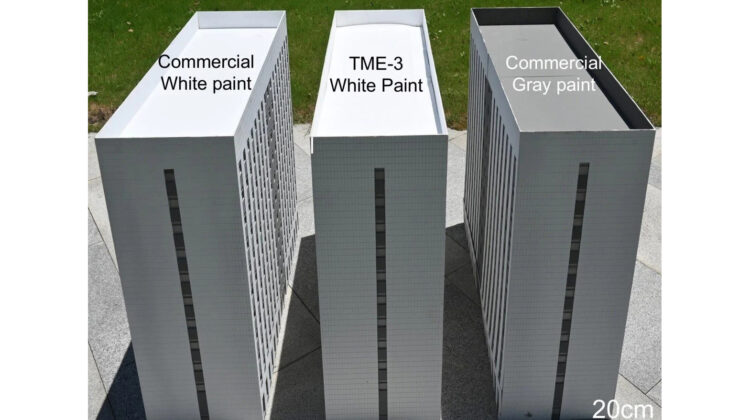
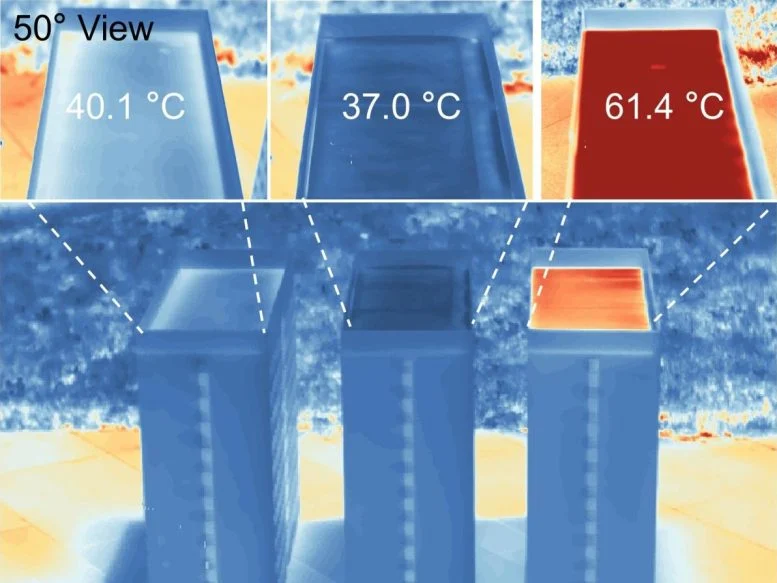
To test their platform, the researchers fabricated four materials to verify the designs. They further applied one of the materials to a model house and compared its cooling effect with that of commercial paints. After a four-hour midday exposure to direct sunlight, the meta-emitter-coated building roof came in between 5°C and 20°C cooler on average than the ones with white and grey paints, respectively.
Advertisement

The researchers estimated that this level of cooling could save the equivalent of 15,800 kilowatts per year in an apartment building in a hot climate such as that of Rio de Janeiro or Bangkok. A typical air conditioning unit uses about 1,500 kilowatts annually.
However, the applications go beyond improving energy efficiency in homes and offices. Using the machine learning framework, the researchers developed seven classes of meta-emitters, each with different strengths and applications.
By reflecting sunlight and emitting heat in specific wavelengths, thermal meta-emitters could be deployed to help reduce the temperature in urban areas. This would mitigate the urban heat island effect, where big cities have higher temperatures than surrounding areas due to a lack of vegetation and high levels of concrete. Beyond our world, thermal meta-emitters could be useful in space to manage the temperature of spacecraft by reflecting solar radiation and emitting heat efficiently.
Beyond the applications in this research, thermal meta-emitters could become a part of many things we use daily. Integrating them into textiles and fabrics could improve cooling technology in clothing and outdoor equipment. Wrapping cars with them and embedding them into interior materials could reduce the heat that builds up when they sit in the sun.
The painstaking traditional process of designing these materials has held them back from mainstream adoption. Other automated options struggle to deal with the complexity in the three-dimensional hierarchical structure of the meta-emitters, limiting the outcomes to simple geometries such as thin-film stacks or planar patterns, with the performance coming up short on some measures.
Advertisement
‘Traditionally, designing these materials has been slow and labour-intensive, relying on trial-and-error methods,’ said Zheng. ‘This approach often leads to suboptimal designs and limits the ability to create materials with the necessary properties to be effective.’
The researchers will continue to refine this technology and apply it to more aspects of their field of nanophotonics – the interaction of light and matter at the tiniest scales.
‘Machine learning may not be the solution to everything, but the unique spectral requirements of thermal management make it particularly suitable for designing high-performance thermal emitters,’ said Kan Yao, a research fellow in Zheng’s group.
The research has been published in Nature.