
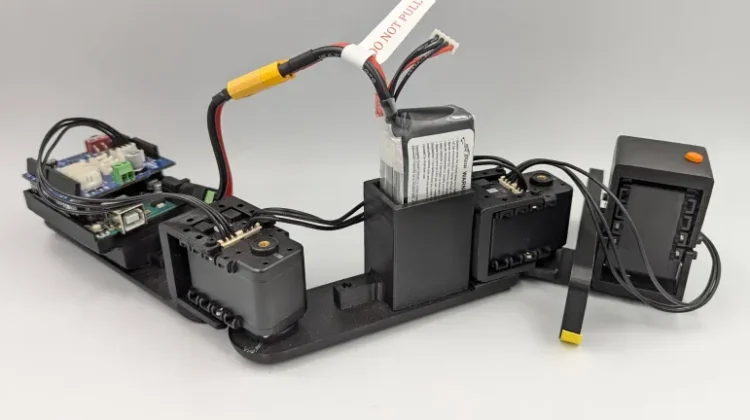
Researchers at the University of Cambridge have developed a fish-like robot that could help explain how some of Earth’s earliest vertebrates first learned to walk on land. The project combined engineering, biology and palaeontology to investigate how several modern fish species move across land and whether their movements can shed light on one of evolution’s most significant milestones – the transition from water to land.
Led by engineers in Professor Fumiya Iida’s laboratory, the team created computer models based on the movements of the grey bichir and several other walking fish species before building a physical robot to test their findings.

The researchers discovered that a range of unrelated fish species have independently evolved the same basic walking pattern, despite being separated across the evolutionary tree. The movement, which they have named the ‘undulating tripod gait’, closely resembles a swimming motion adapted for use on land. Rather than relying on specialised limbs, the fish use their front fins or head to anchor themselves while their tails generate forward movement.
‘If you’ve got the ability to walk on land and your predator doesn’t, then you can escape and hopefully the predator moves on,’ said lead author Dr Michael Ishida, from Cambridge’s Department of Engineering. ‘You’ve also got the ability to move from one shallow-water environment to another, like tide pools for example.’
Advertisement

Using computer simulations, the researchers found the same walking strategy appearing across multiple species, including bichirs, lungfish, catfish, sculpin and snakeheads.
‘We kept seeing this recurring kind of walking motion, although it’s very primitive,’ said Dr Ishida. ‘A number of different fish, spread out across the evolutionary tree, and not closely related to each other, all do it. It’s such a simple movement and can recur from a very basic starting point.’
The team then programmed their robot fish to test different ways of moving across land. After experimenting with a range of walking patterns, they found the most efficient movement closely matched both the computer simulations and the gait used by real fish.
‘We tried all kinds of different gaits on the robot, and every other gait we tried was slower,’ said Dr Ishida. ‘It was surprising that the optimal walking pattern in the simulation and robot matched what the real fish actually do.’
The researchers believe the approach could now be used to study extinct species such as Tiktaalik, a key fossil linking fish and early land-dwelling vertebrates. By combining robotics with computer modelling, they hope to better understand how ancient animals first developed the ability to move onto land.
Advertisement
The findings were published in Nature Communications.
Source: University of Cambridge.