
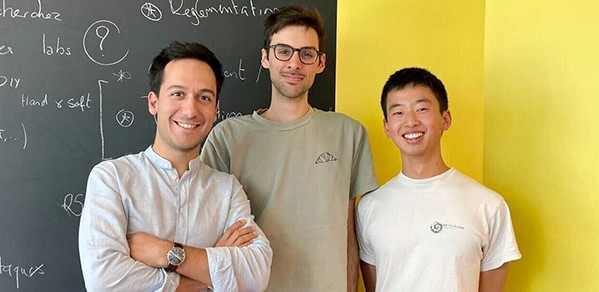
A University of Cambridge engineering graduate has co-founded a deep-tech start-up using artificial intelligence to improve image reconstruction across medicine, science and industry.
Andrew Wang, who studied Information and Computer Engineering as part of his Master of Engineering (MEng) degree, is now chief technology officer and co-founder of Paris-based Blur Labs. The company is developing open-source AI foundation models that can reconstruct higher-quality images from limited or noisy data, with applications ranging from MRI and CT scanning to microscopy and Earth observation.
Wang’s interest in AI began during his time at Cambridge, when he joined Project Odysseus, a research initiative that developed an AI-powered vision monitoring tool to track social distancing across London during the COVID-19 pandemic.
The award-winning system combined computer vision, digital twins and large-scale data infrastructure to provide near real-time information for Transport for London and the Greater London Authority.
Advertisement

‘My second and fourth-year supervisor Professor Mark Girolami was responsible for sparking my interest in AI for scientific applications that benefit society,’ said Wang.
He later completed a PhD at the University of Edinburgh, specialising in AI approaches to image reconstruction. During his research, he worked on the open-source software project DeepInverse, where he met future Blur Labs co-founders Julián Tachella and Matthieu Terris. Together they launched the company in 2025 after joining an incubator at the Inria Saclay Centre in France.
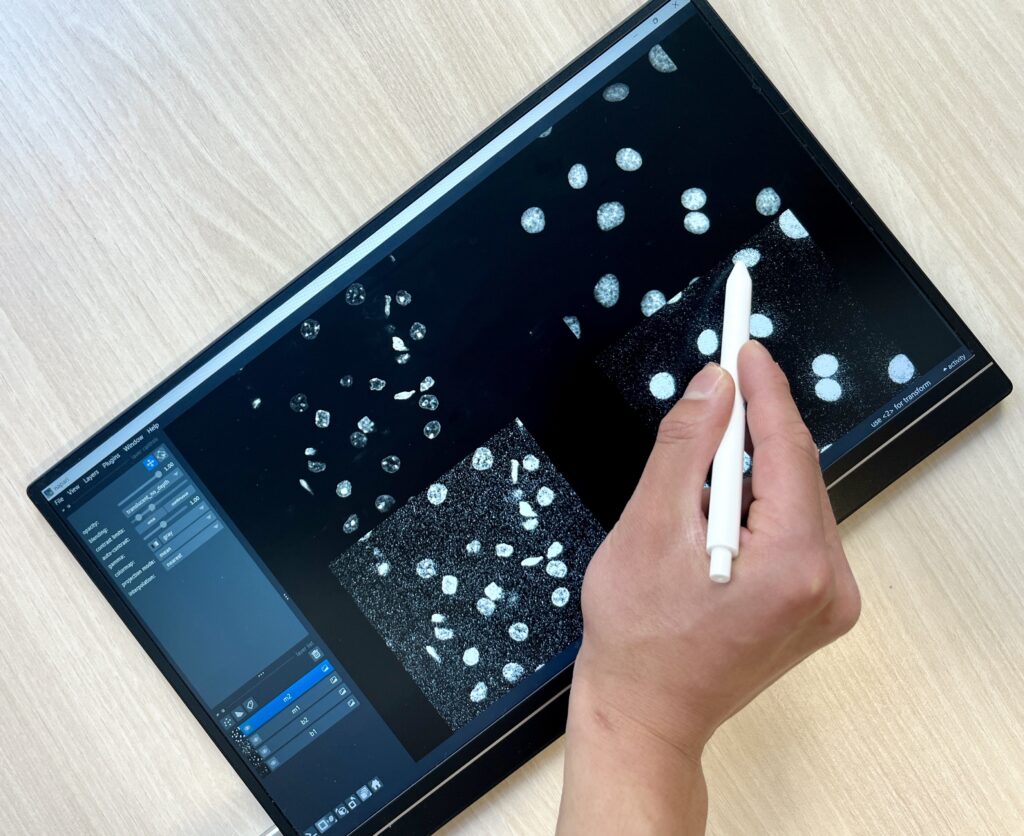
Blur Labs has since developed what it describes as the first open-source foundation model for image reconstruction. The technology is designed to improve image quality while reducing the time and cost associated with acquiring medical and scientific images. The company believes the software could help hospitals increase MRI scanner throughput, thereby speeding diagnosis and treatment, while also supporting portable imaging devices and improving the quality of satellite imagery.

‘Our product is AI software that is integrated into existing and future hardware to maximise the value of the imaging device,’ Wang explained.
The company’s research was presented earlier this year at the International Conference on Learning Representations (ICLR 2026), where experiments demonstrated state-of-the-art performance across applications including medical imaging, microscopy and low-photon imaging. Blur Labs is now developing commercial products based on the research.
Advertisement
Reflecting on his time at Cambridge, Wang said the university gave him both the technical knowledge and wider skills needed to build a technology company.
‘Aside from academia, founding a deep tech start-up, in my opinion, is the most exciting way to use the engineering theory that I learnt at Cambridge,’ he said.
He also credited Cambridge’s collegiate environment and the Department of Engineering’s Centre for Languages and Inter-Communication (CLIC) with helping him develop the communication and intercultural skills that are now essential when working with international investors, customers and collaborators.
Source: University of Cambridge.