
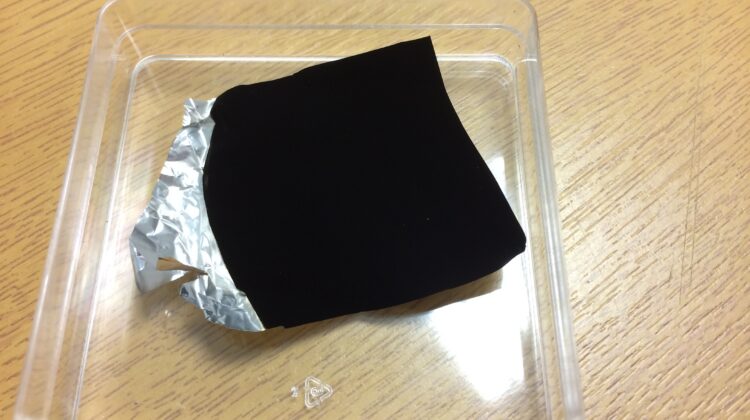
Producing surfaces that absorb almost all visible light remains an important challenge in optical materials engineering. Instead of relying solely on dark pigments, researchers are designing materials with microscopic surface structures that trap incoming light, leaving almost nothing to be reflected. The result is a surface that appears strikingly black, even under bright lighting.
Research published in Matter & Light has moved ultra-black coating technology a step closer to wider industrial use. The team developed a water-based coating using carbon black and carbon nanotubes that absorbs more than 99.9% of visible light while meeting the durability requirements of automotive coatings. Importantly, the material can be produced using manufacturing processes that are far easier to scale than many existing ultra-black materials.
Ultra-black coatings became widely known in 2019 when BMW showed off an X6 concept car painted with Vantablack (an ultra-black carbon nanotube coating). The coating absorbed so much light that reflections nearly vanished, making the car look almost flat. Vantablack works by using millions of tiny carbon nanotubes standing upright to trap light, but making it is complicated and costly, so it’s mostly used for special purposes.

The latest research takes a more practical approach. Instead of growing carbon nanotube forests, the researchers dispersed carbon black particles and carbon nanotubes into a stable coating. Strong interactions between the two materials create a microscopic network that acts as a series of optical traps, forcing light to scatter repeatedly until it is absorbed rather than reflected.
Advertisement

Nature has been using similar principles for millions of years. Deep-sea fish survive in near-total darkness by evolving skin that absorbs almost every photon of incoming light, making them almost invisible to predators. Birds of paradise and some butterfly species achieve the opposite effect. Their ultra-black feathers and wings create a striking contrast with brightly coloured plumage by absorbing so much light that neighbouring colours appear even more vivid. In each case, the effect depends less on pigments than on the microscopic arrangement of the surface itself.

That same idea is now influencing engineering design. Ultra-black coatings are already used inside telescopes to suppress stray reflections that would otherwise interfere with observations of distant galaxies. They also improve the performance of scientific cameras, microscopes and optical sensors by reducing background light. In spacecraft and satellites, highly absorbent coatings help control thermal performance, while solar thermal systems use similar materials to maximise energy capture.
The car industry could benefit too. Many ultra-black coatings have not been durable enough for daily use. The new coating remained firmly attached after tests for humidity and water resistance, suggesting it might perform well in tougher commercial settings.
As engineers design materials at the nanoscale, colour is now more about structure than chemistry. The main challenge is not just making a darker pigment, but shaping surfaces to control how light behaves. If manufacturing continues to improve, ultra-black materials could be used in many areas beyond luxury cars.
The research has been published in Matter & Light and was reported by The Conversation.
Advertisement