
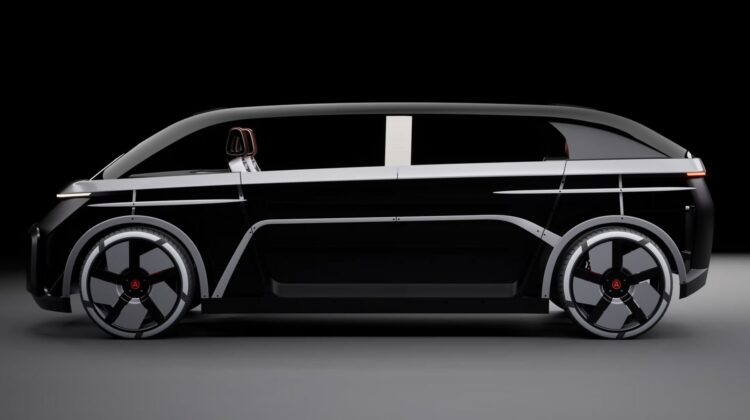
Canada’s Automotive Parts Manufacturers’ Association (APMA) has unveiled the next phase of the country’s national vehicle innovation programme, Project Arrow 2.0, introducing two new advanced electric vehicle prototypes: Project Arrow Vector and Project Arrow Borealis (pictured above).
Civil and environmental engineering professor Mohamed Zaki and his collaborators at Western University in Ontario, including students in the Emergent Mobility for Resilient Communities (EMRC) lab, played a central conceptual and technical role in Project Arrow Borealis. The Western team, working closely with APMA and its partners, delivered critical designs fuelling the latest automotive advancements in AI, autonomous systems and applied engineering research.
Advertisement

Although not formally trained as an automotive designer, Zaki served as a key engineering and systems lead, bridging advanced research expertise, interdisciplinary collaboration and real-world manufacturing constraints to Project Arrow. ‘We weren’t designing something in isolation or as science fiction,’ he said. ‘We started from real constraints – the existing chassis, real dimensions, real manufacturing limits – and worked forward. It was constant problem-solving, back and forth with industry, to make something that looked forward-thinking but was still grounded in reality.’
Introduced in 2023 as the country’s first fully Canadian‑designed, engineered and built zero‑emissions concept vehicle, Project Arrow established a national collaboration across suppliers, academia and technology partners. Phase 2.0 advances that foundation, moving from proof of concept to next‑generation technology deployment. Vector and Borealis are the first iterations of that evolution.
Advertisement
‘Project Arrow began as a national ambition to prove that Canada could design and build its own zero‑emissions vehicle,’ said Flavio Volpe, president of APMA. ‘With Phase 2.0 we are advancing that platform into the technologies, systems and industrial capabilities that will define mobility in the 2030s and 2040s.’
Zaki became involved in Project Arrow when APMA shifted from showcasing an electric vehicle prototype to pursuing a more ambitious goal: the conceptual design of a fully autonomous vehicle with no steering wheel. ‘They didn’t want an incremental improvement or another refined version of an existing car,’ said Zaki. ‘The ask was very clear. We needed to imagine the car of the future, one with no steering wheel, no driver, because the technology changes how we live in the vehicle, not just how we move it.’
Advertisement
Working from the physical dimensions and chassis designs of the earlier Project Arrow vehicle, Zaki and his collaborators reimagined the interior and exterior architecture to reflect a future in which vehicles function as living and working spaces, rather than driver-centric machines. Core design concepts included reconfigurable seating, integrated digital interfaces, adaptable interior layouts and novel approaches to cabin interaction – all aligned with autonomous mobility scenarios.
‘Once you remove the steering wheel, the whole logic of the car changes,’ said Zaki. ‘It’s no longer about driving, it’s about relaxing, working, socialising. We treated the vehicle as a living space rather than a traditional car, and that completely reshaped the interior, the seating and how people interact inside it.’
The highly collaborative design process included frequent technical reviews and validation discussions with APMA engineers and industry partners. While aerodynamic optimisation (maximising its performance by changing its shape to minimise air resistance) and a fully functioning product were outside the project’s scope, the resulting concept vehicle was validated as feasible within ‘real manufacturing boundaries’, meaning it would be possible to produce it.
Advertisement
Zaki and his collaborators delivered a complete conceptual design that balanced speculative innovation with engineering realism. ‘Imagine the future like Knight Rider – a bold vision that once lived only on our TV screens in the 1980s,’ said Zaki. ‘Back then, it felt like fantasy. Today, it’s inspiration. We didn’t just talk about it or scroll through ideas online. We locked ourselves in the lab on Sundays, pulled seats from the office and arranged them in different configurations to see how they worked, and asked the hard questions: what could this look like; how do we solve this? The future isn’t something you wait for. It’s something you build.’
Ultimately, designs developed by Zaki and the team directly informed the next phase of Project Arrow, where the concept was transferred to an internationally recognised automotive designer for refinement and public presentation. With some minor alterations for broader acceptance, the final vehicle retained the core spatial logic, autonomy-first philosophy and experiential intent developed and delivered by Zaki and his collaborators.
Advertisement
Project Arrow Vector represents a near‑term innovation platform engineered to demonstrate commercially scalable Canadian technologies aligned to the 2030 mobility environment. Key innovations include an AI‑formed, 3D‑printed lightweight polymer and aluminium chassis, a 650‑horsepower all‑electric powertrain, an estimated 550‑kilometre range and Level 3 autonomous functionality. Level 3 autonomous vehicles offer ‘conditional automation’, allowing the car to handle all driving tasks – steering, braking and monitoring the environment – in specific scenarios, such as traffic jams or well-mapped highways.
Project Arrow Borealis is the next stage, serving as a research and design platform exploring the long‑range future of Canadian mobility and infrastructure integration. The project aims to achieve fully autonomous Level 5 functionality, smart cities-connected vehicle systems, AI‑designed, 3D‑printed metal‑alloy chassis and powertrain, and zero‑emissions propulsion with a projected 1,500‑kilometre range. Level 5 autonomous vehicles represent full automation, capable of driving themselves anywhere, anytime, under any conditions, without any human intervention.
The initiative reflects the contributions of more than 80 Canadian automotive suppliers and ecosystem partners whose technologies, systems and materials are represented across the Vector and Borealis prototypes.