
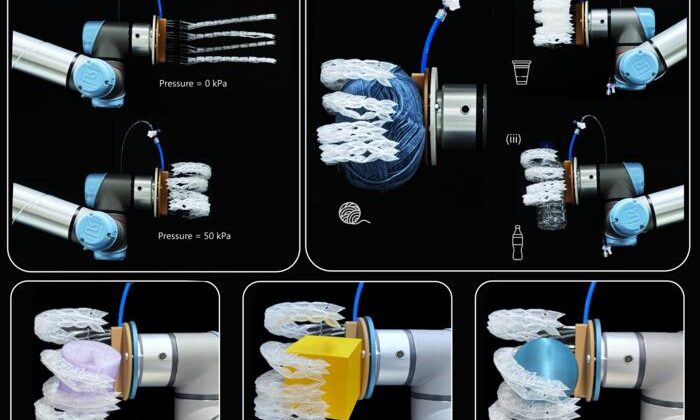
Engineers at the University of Oxford have developed a rapid, ultra-low-cost method for manufacturing soft robots using common lab equipment.
The new technique enables researchers to fabricate soft robotic actuators – the flexible components that power movement – in under ten minutes at a material cost of less than US$0.10 per unit.
‘By lowering the financial and technical barriers to fabrication, this advance could significantly democratise and accelerate soft robotics research and prototyping across laboratories, start-ups, and educational settings,’ said Professor Antonio Forte of the Department of Engineering Science.
Soft robots, made from compliant materials that bend and deform, are increasingly used in applications ranging from delicate object handling to search-and-rescue technologies. However, traditional manufacturing methods often rely on silicone moulding, specialist 3D-printing systems, or complex textile lamination processes – all of which can be time-consuming, costly and equipment-intensive.
Advertisement

The Oxford team’s new approach combines commercially available vacuum-sealable plastic pouches with precision laser cutting. By removing air between layers before laser processing, the researchers can both seal and shape inflatable structures with high accuracy, creating programmable bending actuators in a single cut-and-seal step.
The process requires just three components: commercial thermoplastic vacuum pouches (costing less than ten cents per actuator), a standard vacuum sealing machine and a laser cutter or a desktop laser engraver.
Once fabricated, the inflatable actuators bend predictably when pressurised, enabling complex and programmable movements. Using this approach, the team built a soft robotic gripper capable of lifting 25 times its own weight and ultra-light crawling and swimming robots.
‘Using this approach, we even produced inflatable animal structures, including turtles and cranes,’ said postdoctoral researcher Ashkan Rezanejad. ‘By enabling creative and artistic projects, our method could be particularly valuable for education and attracting students to soft robotics.’
Beyond cost savings, the team systematically tested the mechanical performance and durability of the actuators. The thermoplastic structures demonstrated strong output forces at relatively low pressures and were able to withstand up to 100,000 inflation–deflation cycles during durability tests.

Advertisement
The researchers also developed a computational design framework that allows engineers to ‘programme’ how the actuators bend by adjusting geometric parameters. This enables the creation of predictable shapes, including spirals and letter-shaped structures.
Soft robotic systems are being explored for applications including minimally invasive medical devices, wearable technologies, adaptive manufacturing tools and exploration in hazardous environments. Reducing fabrication complexity may help researchers iterate more quickly and scale new designs more efficiently.
In future work, the researchers intend to explore other compatible thermoplastic materials and how the method could be adapted to enable more complex motions, such as twisting and multi-directional movements.
The research has been published in Advanced Science.