
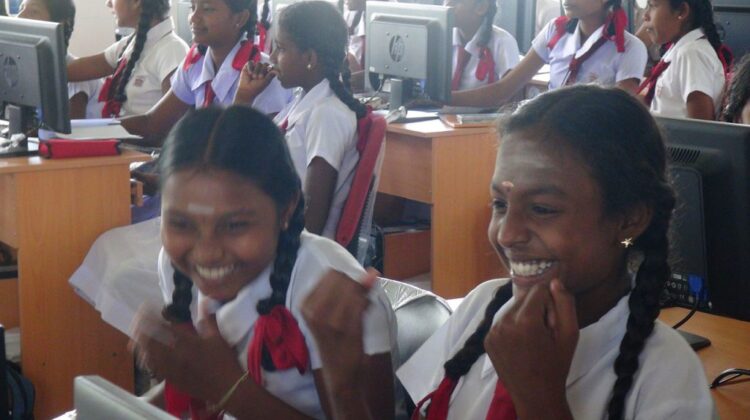
A project designed by a student in the Design Programme at the University of Auckland is empowering girls in New Zealand and Sri Lanka to see themselves in technology careers.
‘If you can see it, you can be it.’ That’s the ethos behind the new research project, which uses extended reality (XR) – a technology that blends virtual, augmented and mixed reality – to explore how interactive learning experiences can inspire girls to see themselves as confident creators in technology.
The work is led by PhD candidate Poornima Meegammana (pictured below). She’s combining her background in design, education and community innovation to explore how new technologies can make digital education more inclusive and personally meaningful.

‘My doctoral project brings together girls in New Zealand and Sri Lanka to co-design and test immersive learning experiences using XR,’ she said. ‘In these interactive settings, students take part in storytelling-led challenges and problem-solving, and meet virtual role models who reflect their cultural and social realities.’
Advertisement

By involving girls as active co-designers, Meegammana’s research ensures the experiences reflect their ideas, challenges and aspirations. The design also includes activities aimed at boosting confidence and problem-solving skills.
The project builds on her more than a decade of work as a social entrepreneur in Sri Lanka, where she has helped thousands of girls and young people access digital education through her initiative NextGen Girls in Technology. For her contributions, she has received global recognition, including the UNESCO Prize for Girls’ and Women’s Education and a place on the Forbes 30 Under 30 Asia list.
Globally, women remain underrepresented in technology fields. In New Zealand, only 27 per cent of the tech workforce is female, while in Sri Lanka, women make up just 20 per cent of ICT students.
Meegammana’s research aims to bridge this gap by addressing early barriers such as limited exposure to technology, a lack of relatable role models and social norms that can affect girls’ confidence. ‘This project looks at how immersive learning can counter stereotypes and help girls imagine themselves in technology careers. It’s about making technology education more creative, inclusive and relevant to their lives,’ she explained.