
Researchers at the US National Institute of Standards and Technology (NIST) have developed five new ways to securely connect large concrete pieces. These connection methods are intended for precast concrete, in which parts such as beams and columns are made in a factory and assembled later at a construction site.
‘Connections are usually the weakest points in this type of construction,’ explained NIST structural engineer Malcolm Ammons. ‘These new connections are designed to make precast concrete buildings more resilient and less likely to collapse after sudden damage such as from a flood, earthquake or explosion.’
Advertisement

Pouring wet concrete at a construction site is expensive and time-consuming. Builders must transport wet concrete to the construction site before it hardens. They must pour the concrete into moulds that are often used only once and then thrown away. Even getting wet concrete into the moulds can be tricky, requiring long hoses and pumps. On top of all those concerns, workers must worry about the weather.
‘Heat, humidity and precipitation all have an effect on the strength of the final concrete,’ said Ammons. ‘Quality control is simpler and overall construction costs are often less expensive if the concrete can be cured indoors.’
Advertisement

That’s where precast concrete comes in. Factory workers pour large pieces of concrete that harden before they are transported to the job site. Construction workers then connect these pieces like Swedish furniture. Precast concrete can greatly reduce the cost of construction and improve quality and consistency because it can be mass-produced in a climate-controlled factory with reusable moulds.
However, precast concrete tends to have more connection points than concrete that is cast on-site. These connections need special attention to ensure that the overall structure is strong.
Advertisement
Workers typically join precast concrete parts by using a steel connector embedded in the wet concrete at the factory. They use steel because it’s a little springy. If you pull hard enough on two ends of a steel bar, it stretches before it breaks apart. Concrete, on the other hand, doesn’t bend or stretch. When it’s put under too much tension, it cracks all at once, instantly transforming from a support to dangerous loose weight.
Precast concrete connections need to be strong enough to hold the everyday weight of the building but should also include intentional weak points that stretch in a predictable way before the concrete breaks apart. In extreme conditions such as earthquakes, when a structure is suddenly put under a lot of physical stress, engineers want that stress to go into the stretchy steel rather than the brittle concrete.
‘You don’t want to be surprised by where the failure is going to happen,’ explained Ammons. ‘You want to be able to dictate where and how the failure occurs.’
Advertisement
This design principle helps ensure that damage like the loss of a column doesn’t spread to other parts of the structure and lead to a larger collapse. Preventing this effect, which engineers call ‘disproportionate collapse’, has been a major priority of NIST research for several decades.
To study disproportionate collapse, NIST ran a series of full-scale tests on different types of construction to see whether they could withstand the sudden destruction of a column. During those tests, NIST researchers found that the precast concrete connections might not survive the destruction of a supporting column. ‘The connections fractured in unexpected places, rather than deforming in a ductile manner as intended. We saw an opportunity to design more robust connections,’ said NIST researcher Joseph Main.

Advertisement
NIST teamed up with the Precast Concrete Institute (PCI), a professional association, to come up with five new ideas for precast concrete connections.
‘You want to have a balance between performance, cost and constructability. Having a few different types of connections will help civil engineers choose the right one for their building,’ said Ammons.
The new connectors come in many shapes and sizes, including metal plates that are welded together, brackets that can be screwed together with huge bolts and peg-in-hole systems where long steel rods extending out of one piece are inserted into holes in another piece and held together with mortar.
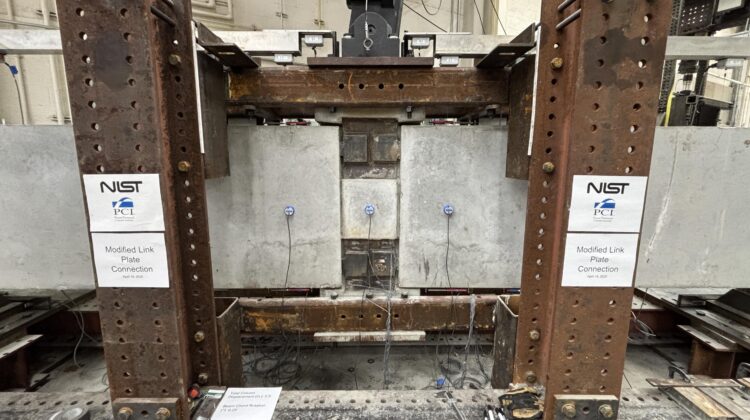
These connections worked in theory and in simulations, but the connections also needed to be physically tested. To run real-world tests, NIST and PCI created five-eighths-scale samples of these connections, embedded with sensors to constantly measure the forces throughout the concrete.
At NIST’s structural testing laboratory in Gaithersburg, Maryland, these protypes were pushed to their limits by hydraulic actuators. NIST engineers watched carefully as they applied more than 34 tonnes of force to see how the steel stretched and where cracks formed in the concrete. These tests confirmed that all five of these new connection types would be more effective at preventing disproportionate collapse than the connections NIST had previously tested.
Through this testing, NIST engineers confirmed that these connections are robust. They could keep a structure standing, even if a column beneath it was suddenly destroyed. Because these connections were designed with input and feedback from precast concrete manufacturers through NIST’s collaboration with PCI, the designs are also usable – they can be built in existing factories and are easy to assemble at a construction site.
‘We want people to use these new connections,’ said Main. ‘We hope this innovation will help the precast concrete industry to design and construct robust buildings that can survive unanticipated loads, like a vehicle impact or an explosion, giving people time to evacuate and saving lives.’