
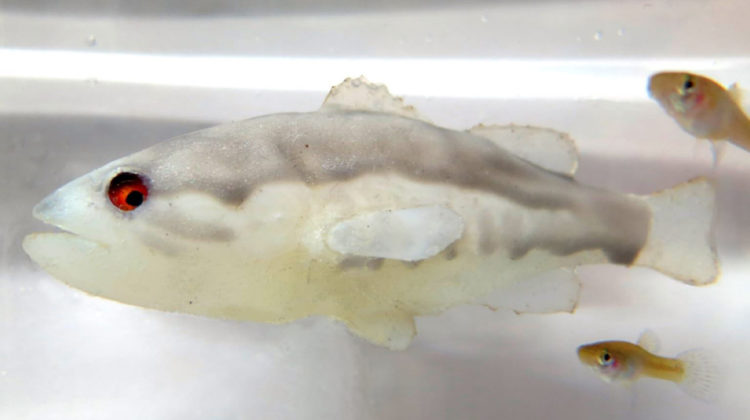
An international team of researchers has designed a robotic fish that scares away mosquitofish, a predator that has been introduced into aquatic environments in several countries, causing the decline of native species.
The team, which contains scientists from the University of Western Australia, the University of Padova in Italy and New York University have demonstrated that even brief exposures to their robotic predator can alter mosquitofish behaviour, increasing fear and stress responses in the invasive species and reducing its negative impact on native Australian tadpoles.
Advertisement

According to the study’s lead author, Giovanni Polverino, Forrest postdoctoral fellow in UWA’s School of Biological Sciences, the mosquitofish, which is native to the southern USA – is one of the 100 worst invasive species, threatening freshwater fish and amphibians globally.
The team developed its robotic predator to closely mimic the appearance and movement patterns of the mosquitofish’s main predator in the USA, the largemouth bass, which has successfully controlled mosquitofish for centuries.
Advertisement

‘Our robot fish was designed to copy the largemouth bass, and we equipped it with a computer-vision system that allowed the robot to differentiate in real time between mosquitofish and the tadpoles of a common Australian frog, which is negatively impacted by mosquitofish in the wild,’ Polverino said. ‘The robot simulated realistic attacks toward mosquitofish when it approached the tadpoles, which we found changed the behaviour of the entire group of mosquitofish, in that they were less active and more anxious, and therefore less of a threat for the tadpoles.’
According to Polverino, the new research represents significant progress in the emerging field of ethorobotics, which involves using biologically inspired robots to interact with live animals in order to aid understanding of how animals communicate and interact with one another.
Advertisement
‘Except for immediate changes in behaviour, we didn’t know much about what happens to animals after they’re exposed to robotic predators,’ Polverino said. ‘We show that such exposure has long-term effects on animals, which were until now invisible due to technical and conceptual gaps in the field.
‘Our research fills those gaps and offers the first evidence of a robot that can selectively control the behaviour of invasive fish, undermining their survival, reproduction and ecological success, and alleviating their negative impact on native animals,’ he continued. ‘It gives us some optimism for the future of freshwater ecosystems, which host more than a quarter of the world’s vertebrates, most which are at the risk of perishing because of the spread of invasive species.’
The study has been published in the online journal iScience.