
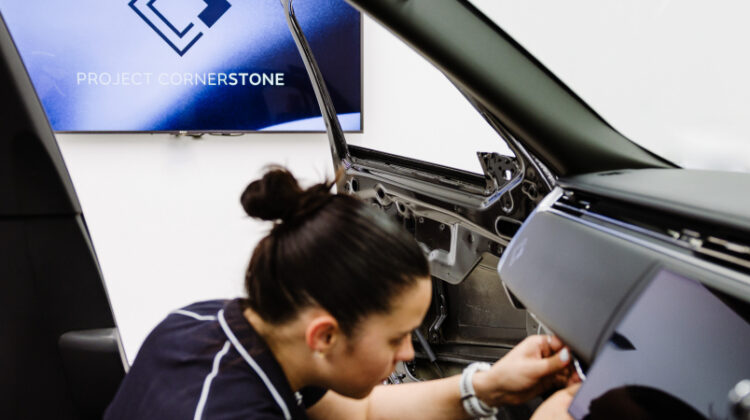
Jaguar Land Rover (JLR) has unveiled a new concept demonstrator vehicle that showcases the company’s latest progress in circular design, low‑carbon engineering and next‑generation material innovation.
JLR’s engineering and industrial operations teams have collaborated with more than 40 Tier 1 and raw material suppliers to create 49 more sustainable automotive components by maximising recycled, bio‑based and low‑impact materials, and designing parts so they can be taken apart for recycling and repair.
The ‘Cornerstone’ project has delivered more than a tonne of CO₂-equivalent savings, the equivalent of a passenger flying from Paris to New York. It has also achieved an increase of almost 140 kilograms of recycled material.
By producing parts for a real bodyshell, the project helps to establish clear pathways for integrating breakthrough solutions into JLR’s current and future vehicle programmes, with new headlamp technology, lower‑emission steel, recycled door glass, recycled seat foam and new FlexAir seat technology already planned for upcoming models.
Advertisement

The project has also resulted in multiple industry firsts, including 100 per cent closed‑loop recycled glass with a 36 per cent CO₂e reduction and initiatives affecting critical materials, such as de‑bondable electronics that enable headlamp repair and recycling, and 95 per cent recycled magnets in speakers.
‘What we’re achieving with Cornerstone shows how JLR can lead in advancing circularity across the automotive industry, and the value of a coordinated, multi‑party approach to deliver progress faster,’ said Paul Francis, senior manager circularity at JLR. ‘It’s essential we maintain the highest performance and quality standards. When we engage early on shared goals and each partner in the value chain brings their expertise collaboratively throughout development, production efficiency and overall outcomes improve significantly. This is how real, honest progress is made, and how the economic opportunity of circularity can be realised.’
New advancements from JLR’s Circularity Lab, which explores the most effective ways to recover value from end‑of‑life vehicles by improving how easily parts can be reused, repaired and recycled, will continue to feed into Cornerstone, ensuring it evolves as new solutions emerge. According to JLR, by proactively advancing automotive circularity, the company is helping to build the capabilities needed for long‑term resource security, industrial decarbonisation and stronger supply‑chain resilience.
JLR also recently joined the Global Impact Coalition’s Automotive Plastics Circularity Project. Found throughout the vehicle, from seats to dashboards, bumpers and lights, automotive plastics are challenging to separate, sort and recycle. The project seeks to overcome barriers for end‑of‑life plastics so that waste plastics can be transformed into valuable high‑quality recycled material for use in new vehicles.