
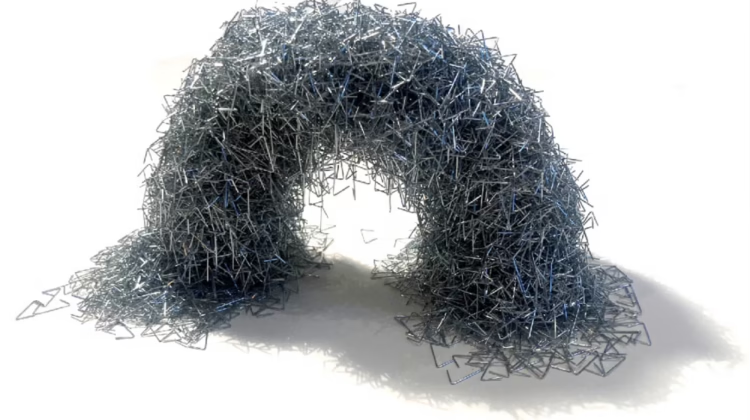
A team of engineers and materials scientists in the Paul M Rady Department of Mechanical Engineering at University of Colorado Boulder is exploring a new class of materials that’s built on interlocking particles.
Their inspiration comes from the behaviour of tightly packed balls of office staples. Try to pull the ball apart and the tangled metal resists like a solid object, but with the right movement or vibration, that same bundle can quickly fall back into loose pieces. By mimicking the way in which staples lock together and release, the researchers believe that these emerging materials could one day form structures that are strong, adaptable and even recyclable.
‘We’ve been playing around with the idea of building blocks and geometry for many years, but we started looking at interlocking, entangled particles only recently,’ said Professor Francois Barthelat, the leader of the Laboratory for Advanced Materials & Bioinspiration. ‘We are excited about the combination of properties we can get out of these systems and we believe this technology has the potential to go in many directions.’
The work focuses on what the researchers call ‘entanglement’ – when multiple particles become intertwined with one another, creating a link. It’s not a new concept. In fact, nature is filled with examples of objects or materials that tangle and interlock with each other to create strong structures – for example bird nests made from interwoven sticks and fibres, or the interplay of hard minerals and soft proteins in human bones.
Advertisement

But how can scientists recreate that kind of natural entanglement in manufactured materials? The researchers in Barthelat’s lab say the answer revolves around one key concept: particle shape.
‘Let’s take sand as an example. Sand is smooth and convex-shaped, meaning it cannot interlock from grain to grain,’ said PhD student Youhan Sohn. ‘However, we found that if we change the shape of a grain of sand, we can drastically affect its behaviour and mechanical properties, including the particle’s ability to link with other particles.’
Once the researchers came to this realisation, they began running Monte Carlo simulations, a type of computational analysis, to predict exactly how the particles interlock with each other. Their goal was to find the optimal geometry that delivered the maximum entanglement.
After finding the optimal shape, the team performed pickup tests to see how the entangled particles actually behaved. The tests showed that a ‘two-legged’ particle – similar in shape to a staple – had the greatest potential for entanglement. But the researchers also discovered several unexpected advantages that made the design even more intriguing.
The first was its rare blend of tensile strength and toughness, a combination the researchers say conventional materials rarely achieve simultaneously. ‘Our entangled granular material using the staple-like particle demonstrates both high strength and toughness at the same time,’ said PhD student Saeed Pezeshki.
Advertisement
Next, was its unique ability to rapidly assemble – and just as quickly come apart. By applying different vibrational patterns to the material, the team was able to change its level of entanglement on demand. A light vibration, for example, could be used to interlock and strengthen the particles, while a larger vibration could cause them to completely unravel.
‘It’s a strange material because it’s obviously not a liquid. However, it’s also not quite solid. This opens new and intriguing engineering possibilities,’ Barthelat said. ‘Handling a bundle of these entangled particles feels very remote and exotic.’
One of those possibilities comes in the realm of sustainability. The group believes that one day, large buildings and structures such as bridges can be designed using entangled materials, allowing them to be disassembled when no longer needed, or even fully recycled. Or maybe entangled materials can make their way into robotic systems, similar to those depicted in sci-fi movies. ‘I was talking with other students who believe this technology can be used in swarm robotics – where small robots can entangle, do a task and then disentangle when they are done,’ said Pezeshki.
For now, the group is focused on building out the next phase of their research. They are currently testing a new particle shape with added protruding ‘legs’ – similar to spiky plant burrs – which they believe can generate even stronger entanglement properties.
The research has been published in the Journal of Applied Physics.