
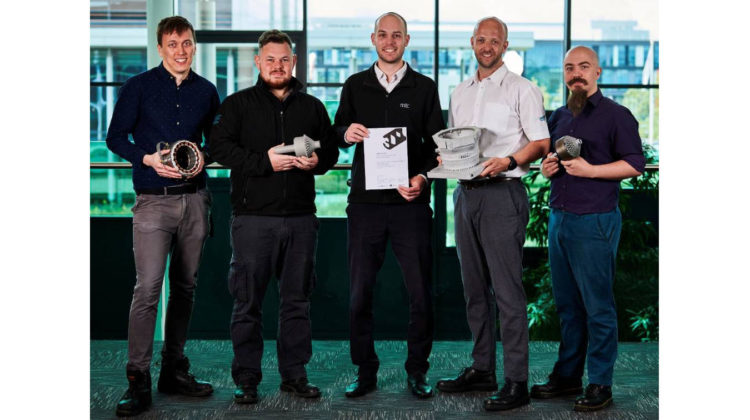
A team of engineers from the Manufacturing Technology Centre (MTC) in Coventry has won the 2022 3D Pioneers Challenge award, an international design competition for advanced manufacturing technologies, for the development of a high-powered electric motor that’s smaller and lighter, thanks to advanced manufacturing technologies.
As part of the MTC’s Future Electric Motor Systems aerospace motor project, known as FEMS3, the team redesigned an MTC-designed motor casing for a lightweight aerospace application. They used additive manufacturing technology to combine three machined components, eight fasteners and three O-rings into a single part. The result was a motor more than 65 per cent lighter and is much simpler to assemble.
The team also redesigned components in the rotor assembly, allowing four parts made from three materials to be consolidated into a single component, further reducing weight and simplifying assembly.
In their comments, the competition judges congratulated the team for taking advantage of the benefits of additive manufacturing. ‘Leveraging these advantages to design and manufacture a bespoke element of such a complex product and thus system integration at such a high level is very impressive,’ they said. ‘The team achieved weight reduction of a functional electric motor, with sustainability in the overall concept. Motors consume a huge portion of energy in industry, so ideas to improve electric motors by additive manufacturing is a great lever towards higher performance and thus improved sustainability.’
Advertisement

‘The aerospace motor we have developed showcases the potential of additive manufacturing and advanced design tools to manufacture high-performance electric motors, said Ollie Hartfield, an MTC research engineer and member of the FEMS3 team. ‘The key benefits include being able to reduce the lifetime environmental impact compared to conventional manufacturing, as well as offering a lighter motor with increased performance and greater ease of assembly.’