
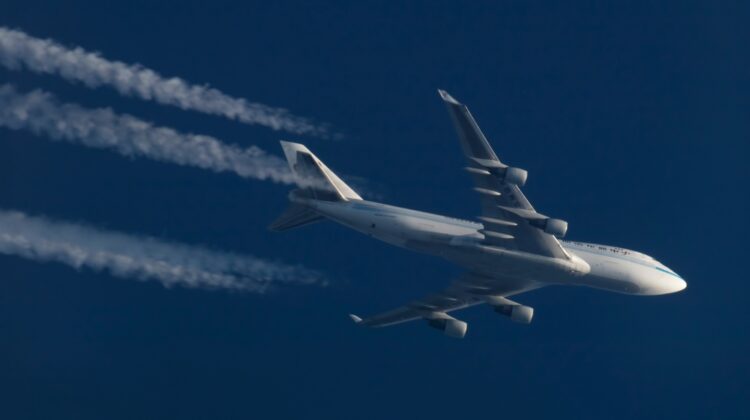
Most attempts to reduce aviation’s climate impact focus on what powers an aircraft. A new UK-led trial is looking instead at where an aircraft flies, testing whether relatively small changes in altitude could prevent some of the condensation trails that contribute to global warming.
Operation Blue Skies will conduct what its partners describe as the world’s first airspace-wide contrail avoidance trial. The 30-month programme brings together the University of Cambridge, Imperial College London, Google, the Met Office, NATS and Contrails.org, with £2.65 million of its £5 million budget provided by the Department for Transport.
Contrails form when water vapour in jet exhaust condenses and freezes around soot particles and other aerosols in cold, humid air at altitude. Many disappear quickly, but under particular atmospheric conditions they can persist and spread into thin clouds. These persistent contrails trap outgoing heat and are estimated to account for roughly a third of aviation’s overall climate impact.
The engineering challenge is that those conditions are not distributed evenly through the atmosphere. Operation Blue Skies will use AI-based models to predict areas where persistent contrails are most likely to form, allowing air traffic controllers and airlines to investigate whether aircraft can be routed above or below them.
Advertisement

Rather than introducing completely new flight procedures, the trials will concentrate on relatively minor altitude changes made through existing air traffic control communication channels. Testing will take place in NATS-controlled Shanwick airspace, covering the eastern half of the North Atlantic corridor.
It is a useful place to test the idea. Atmospheric modelling indicates that Shanwick airspace is responsible for around 5% of global contrail warming, with a significant proportion occurring between November and February. Around 20 to 40 trial days are planned during each of the 2026–27 and 2027–28 winters, primarily when air traffic is lower.
Researchers at Cambridge and Imperial will independently evaluate the results to establish whether the changes produce a measurable climate benefit. Importantly, the programme will also examine whether contrail avoidance can work within the practical constraints of managing busy commercial airspace.
‘Contrail avoidance could drastically reduce the global climate impact of aviation, at minimal cost to passengers and companies,’ said Professor Steven Barrett, Regius Professor of Engineering at Cambridge. ‘Operation Blue Skies is a big step forward in this process, as it will test the ability of the UK to reduce contrail coverage at an airspace-wide scale and in a real-world setting.’
The significance of the trial lies partly in its simplicity. Developing new aircraft and lower-carbon fuels takes years, whereas changing altitude is something existing aircraft can already do. The question Operation Blue Skies now has to answer is whether thousands of flights can make those changes safely and efficiently while producing a meaningful reduction in aviation’s climate impact.