
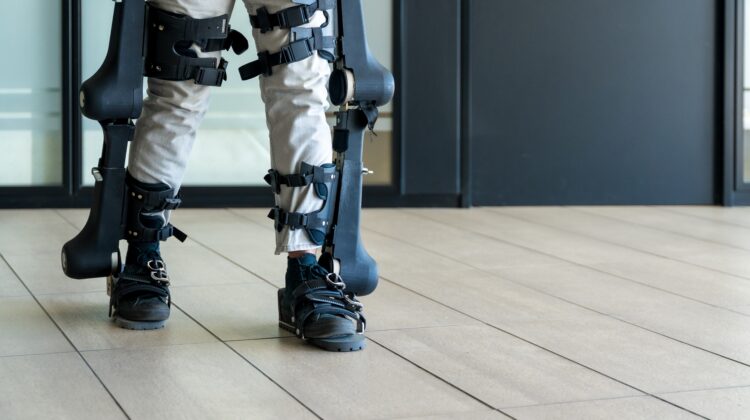
An exoskeleton that helps someone climb stairs may not know what to do when they suddenly stop, turn around or begin walking across uneven ground. Researchers are now looking at whether artificial intelligence could make these wearable machines better at adapting as their users move.
A paper co-authored by researchers at Georgia Tech and Northeastern University sets out a roadmap for task-agnostic exoskeleton control. Instead of programming an exoskeleton around a limited number of predefined activities, the approach would use real-time estimates of the wearer’s movement to decide how and when assistance should be provided.
That could make lower-limb exoskeletons more useful outside controlled environments, where people rarely walk at one speed or perform movements in a predictable sequence. Potential applications include supporting people with mobility impairments and older adults, as well as reducing physical strain for workers carrying out demanding tasks.
The challenge is making that adaptability reliable. The researchers identify sensing, optimisation, safety and access to suitable training data among the problems that still need to be addressed before more general-purpose control systems can become practical.
Advertisement

The work, published in Nature Machine Intelligence, is therefore a roadmap rather than a demonstration of a finished autonomous exoskeleton. But it points towards wearable robots that respond continuously to what their user is doing, rather than requiring the user to fit their movements around the machine.
The research is published in Nature Machine Intelligence.