
Getting water to condense isn’t particularly difficult. Getting it to condense efficiently, and then move out of the way quickly enough for the process to start again, is rather more complicated.
Engineers at KAIST have developed an ultrathin polymer coating that tackles both sides of that problem. Applied to copper tubes, the surface achieved condensation heat transfer performance up to 5.5 times greater than a conventional copper surface covered by a water film.
The work, led by Professor Youngsuk Nam from KAIST’s Department of Mechanical Engineering and Professor Sung Gap Im from the Department of Chemical and Biomolecular Engineering, was published in Nature Communications.
Condensation is central to a surprising amount of engineering. Power stations rely on it to turn steam back into water, desalination systems use it to recover fresh water, and thermal management systems use phase changes to shift heat away from components. In each case, how water behaves on a surface can make a substantial difference to performance.
Advertisement

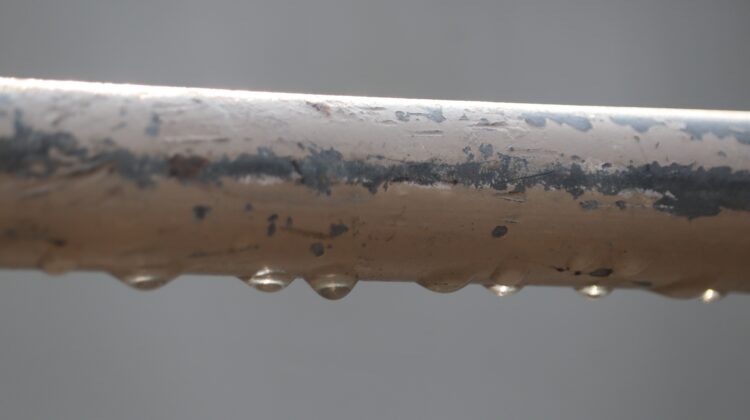
On an ordinary metal surface, condensed droplets can merge into a continuous film. That layer of water becomes an additional thermal barrier between the vapour and the surface beneath it. Dropwise condensation is preferable: individual droplets form, grow and leave, repeatedly exposing fresh surface for the next condensation cycle.
There is a catch. Surfaces that provide plenty of sites for droplets to nucleate can also hold onto them rather stubbornly. Make a surface smoother or more water-repellent and the droplets may leave readily, but fewer form in the first place.
The KAIST team found a way to control the two processes separately.
Using initiated chemical vapour deposition (iCVD), the researchers deposited an extremely thin polymer film onto the surface. As the film became thinner, nanoscale polymer aggregates appeared. Such features might ordinarily be treated as coating defects, but here they proved useful, providing additional sites for condensation to begin. The thinner films produced around three times as many droplets as thicker versions.
A subsequent heat treatment addressed the other half of the problem by reducing the force holding water droplets to the surface. Droplets could therefore detach while still relatively small, clearing space for another condensation cycle to begin.
Advertisement
Put together, those two changes produced a sizeable improvement. When tested on copper tubes used in condensers, the coated surface reached a maximum condensation heat transfer coefficient of approximately 88kW/m²K, up to 5.5 times the performance of conventional filmwise condensation on copper. It also delivered more than 50 per cent higher performance than a conventional hydrophobic coating, according to the researchers.
Perhaps the neatest part of the work is that the nanoscale features responsible for improving nucleation weren’t originally the sort of thing engineers would necessarily want. Instead of chasing an immaculate polymer surface, the team turned apparent imperfections into functional parts of the coating.
There is also a practical manufacturing advantage. The iCVD process can deposit thin, uniform polymer films over complex geometries, potentially making the approach useful beyond flat laboratory samples.
The researchers see possible applications in industrial condensers and heat exchangers, where better heat transfer could improve overall energy efficiency. More efficient condensation could also benefit desalination and water-harvesting equipment, while improved heat removal may offer another route to cooling increasingly power-hungry electronic systems.
It remains to be seen how the coating performs over the long operating lives and demanding conditions expected of industrial equipment. Even so, the work shows how manipulating a surface at the nanoscale can have a much larger effect on the thermal performance of the system around it.
Research published in: Nature Communications