
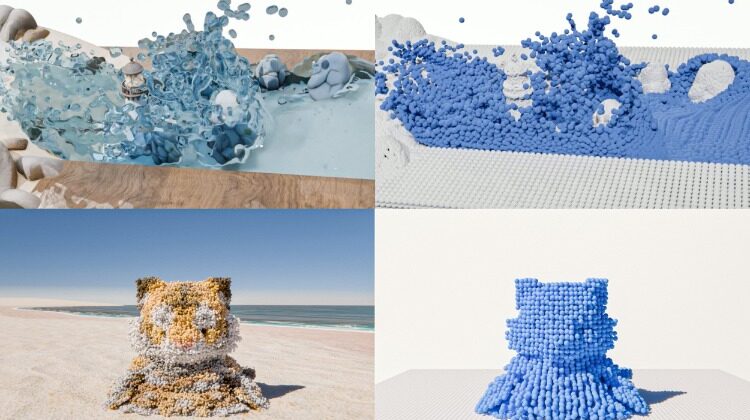
Oil moving inside a tank and the flexible valve it pushes against present different modelling problems. Engineers may need separate simulation tools to understand each material, then work out how to connect them.
A new artificial intelligence system developed by researchers at MIT, the University of British Columbia and other institutions could bring those calculations closer together.
Called WorldParticle, the system uses a single AI architecture to model different types of physical behaviour, from flowing liquids and shifting sand to deformable objects and moving protein structures.
For engineering designers, the potential lies in modelling interactions between materials that would usually require different specialist tools. Applications could include studying how a soft robot moves through loose soil or how liquid movement affects a flexible component.
Advertisement

WorldParticle represents the material being simulated as thousands or millions of particles. Their positions and physical properties are fed into a neural network, which predicts how they will move during the next simulation step.
Rather than relying on a separately programmed solver for each type of material, the system learns patterns of physical behaviour from training data.
‘Our vision is to have a foundation model that works out of the box for any scenario you want to simulate,’ said Peter Yichen Chen, a former MIT postdoctoral researcher who is now an assistant professor at the University of British Columbia. He described the work as a first step towards that goal.
A key part of the approach is how it handles external forces. Before each prediction, WorldParticle separates those forces from the material’s internal behaviour. It then incorporates their effects back into the calculation, adjusting the predicted particle movements.
The researchers say this helps the system respond to forces and conditions it did not encounter during training.
Advertisement
Scale presented another challenge. Tracking millions of individual particles can quickly become computationally demanding. The team therefore developed a method for merging and compressing particle information while retaining detail about the material’s behaviour.
The researchers demonstrated the system across six types of physical phenomena. In one example, it captured a granular object collapsing into a pile, avoiding errors seen in some comparison methods that left particles suspended in the air.
The team also reported modelling changes in protein structures around 100 times faster than the numerical simulators used for comparison. That result relates to the protein tests, rather than a universal speed improvement across every application.
WorldParticle remains a research system. Its broader ambition is to give scientists and engineers a more general tool for investigating physical interactions, with further work planned to extend the range of systems it can simulate.
For designers working with flexible components, fluids and granular materials, the prospect is a more connected way to explore how those elements behave together.