

A unique new material that shrinks when heated and expands when cooled could help enable the ultra-stable space telescopes that future NASA missions require to search for habitable worlds.
One of the goals of NASA’s Astrophysics Division is to determine whether we’re alone in the universe. NASA’s astrophysics missions seek to answer this question by identifying planets beyond our solar system (exoplanets) that could support life. Over the last two decades, scientists have developed ways to detect atmospheres on exoplanets by closely observing stars through advanced telescopes. As light passes through a planet’s atmosphere or is reflected or emitted from a planet’s surface, telescopes can measure the intensity and spectra of the light, and can detect various shifts caused by gases in the planetary atmosphere. By analysing these patterns, scientists can determine the types of gasses in the exoplanet’s atmosphere.
Decoding these shifts is no easy task because the exoplanets appear very near their host stars, and the starlight is one billion times brighter than the light from an Earth-size exoplanet. To successfully detect habitable exoplanets, NASA’s future Habitable Worlds Observatory will need a contrast ratio of one to one billion.
Achieving this extreme contrast ratio will require a telescope that is 1,000 times more stable than state-of-the-art space-based observatories such as NASA’s James Webb Space Telescope. New sensors, system architectures and materials must be integrated and work in concert for future mission success. A team from the company ALLVAR is collaborating with NASA’s Marshall Space Flight Center and Jet Propulsion Laboratory to demonstrate how integration of a new material with unique negative thermal expansion characteristics can help enable ultra-stable telescope structures.
Advertisement

Material stability has always been a limiting factor for observing celestial phenomena. For decades, scientists and engineers have been working to overcome challenges such as micro-creep, thermal expansion and moisture expansion, which detrimentally affect telescope stability. The materials currently used for telescope mirrors and struts have drastically improved dimensional stability, but they still fall short of the ten-picometre (roughly one-tenth the diameter of an atom) level stability over several hours that will be required for the Habitable Worlds Observatory.
ALLVAR’s alloy shrinks when heated and expands when cooled – a property known as negative thermal expansion (NTE). For example, ALLVAR Alloy 30 exhibits a –30 ppm/°C coefficient of thermal expansion (CTE) at room temperature. This means that a one-metre-long piece of this alloy will shrink 0.003 millimetres for every 1°C increase in temperature. For comparison, aluminium expands at +23 ppm/°C.
Because it shrinks when other materials expand, ALLVAR Alloy 30 can be used to strategically compensate for the expansion and contraction of other materials. The alloy’s unique NTE property and lack of moisture expansion could enable optic designers to address the stability needs of future telescope structures. Calculations have indicated that integrating ALLVAR Alloy 30 into certain telescope designs could improve thermal stability up to 200 times compared to only using traditional materials such as aluminium, titanium, carbon-fibre-reinforced polymers and the nickel–iron alloy, Invar.
To demonstrate that NTE alloys can enable ultra-stable structures, the ALLVAR team developed a hexapod structure to separate two mirrors made of a commercially available glass ceramic material with ultra-low thermal expansion properties. Invar was bonded to the mirrors and flexures made of Ti6Al4V – a titanium alloy commonly used in aerospace applications – were attached to the Invar. To compensate for the positive CTEs of the Invar and Ti6Al4V components, an NTE ALLVAR Alloy 30 tube was used between the Ti6Al4V flexures to create the struts separating the two mirrors. The natural positive thermal expansion of the Invar and Ti6Al4V components is offset by the negative thermal expansion of the NTE alloy struts, resulting in a structure with effectively zero thermal expansion.
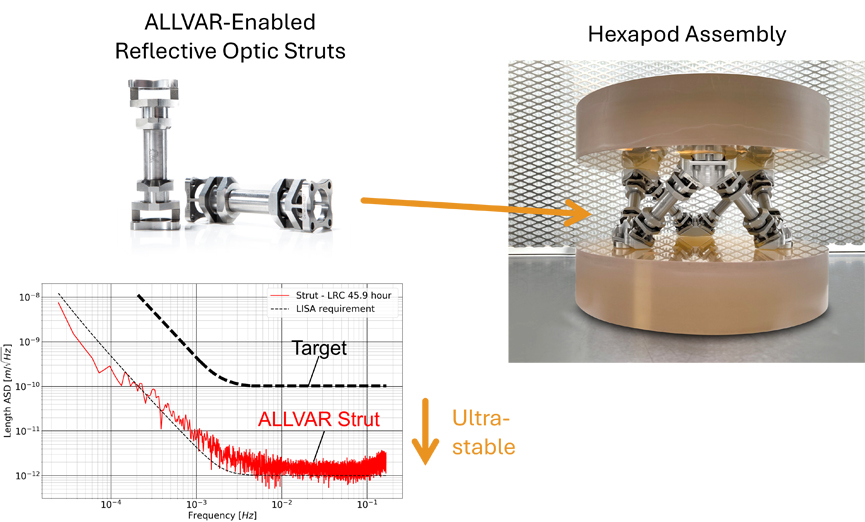
The ALLVAR team has worked with NASA’s Jet Propulsion Laboratory to develop detailed datasets of ALLVAR Alloy 30 material properties, helping to clear a major hurdle towards space-material qualification.
Advertisement
As a spinoff of this NASA-funded work, the team is developing a new alloy with tuneable thermal expansion properties that can match other materials or even achieve zero CTE. Thermal expansion mismatch causes dimensional stability and force-load issues that can affect fields such as nuclear engineering, quantum computing, aerospace and defence, optics, fundamental physics and medical imaging. The potential uses for this new material will likely extend far beyond astronomy. For example, ALLVAR-developed washers and spacers are now commercially available to maintain consistent preloads across extreme temperature ranges in both space and terrestrial environments. These washers and spacers excel at counteracting the thermal expansion and contraction of other materials, ensuring stability for demanding applications.