
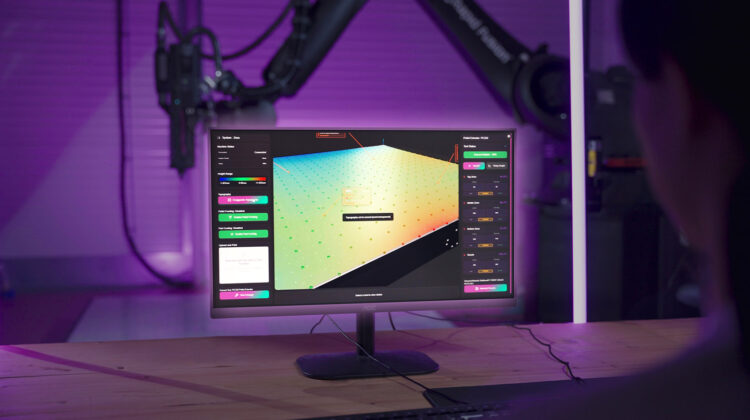
Exeter-based technology specialist Rapid Fusion has unveiled a new AI ‘print assistant’ that will help enhance the performance of its robotic additive manufacturing systems. According to the company, its developers have leveraged the power of AI to optimise solutions for customers printing complex components for the automotive, aerospace, construction, medical and military sectors.
After eight months of coding, troubleshooting and various live tests, Bob (Base of Build) is now being rolled out to existing clients. Rapid Fusion says that Bob will optimise its robots by making them easier to use, providing greater operator control and ensuring less downtime through preventative maintenance.
Advertisement

The pre-loaded knowledge bank, anticipated to be one of the largest collections of 3D-printing expertise ever created, works in both secure online/cloud-connected and offline/air-gapped configurations for military or IP-sensitive clients.
Bob works with Rapid Fusion’s existing models, including Apollo and Zeus, and with its most recent system, Medusa, the first UK-built large-format hybrid 3D gantry printer.
Advertisement

‘Having our own AI “print assistant” is a gamechanger and will cut machine downtime and boost efficiency,’ said Martin Jewell, chief technology officer at Rapid Fusion. ‘We’re teaching our systems to understand challenges and different scenarios, which means we can make the user interface more responsive and simpler to embrace – opening it up to the whole workforce. In essence, if we can make our systems as ‘plug and play’ as possible it means we will have more adopters. It’s a simple as that.’
Rapid Fusion, which employs ten people at its demo centre in Exeter, has factored more than 1,000 different printing parameters into its AI language to come up with ‘best-in-class’ settings for more than 100 different components. They feature smart-extrusion readiness, which analyses the live temperature across four heating zones with rolling stability windows – in essence, providing confidence-scored go/no-go decisions using realistic heating/cooling profiles per material and pre-determined safety thresholds.
Advertisement
Material-aware intelligence also covers extensive variants, including carbon-fibre composites and high-temperature polymers. When users say, ‘I need to print a high-temp mould tool,’ the AI accesses complete profiles considering heat deflection temperatures, mould shrinkage, thermal expansion and mechanical properties for optimal configuration.
‘There’s lots more,’ Jewell said. ‘Task completion orchestrator operates three-tier intent processing; fast pattern matching for simple commands, AI interpretation accesses comprehensive material databases for complex requests, and advanced contextual understanding ensures accurate execution across all scenarios.
‘Finally, the AI temperature command handler includes “smart chained” intentions that combine multiple actions,’ he concluded. ‘For example, natural requests trigger automated sequences selecting appropriate materials, configuring multi-zone temperatures, evaluating post-processing requirements and optimising based on embedded engineering data for the specific application. There’s a huge pre-loaded knowledge based, covering all of our products, maintenance guides, troubleshooting and practical print flows. We believe we’ve come up with a true additive-manufacturing “knowledge bible”.’
Advertisement
To begin with, there will be two levels of users: a super user, such as a trusted partner or university that can continue to inform and iterate the way Rapid Fusion does things and then a standard offer released at the start of 2026 for everyone who has one of the company’s systems.