
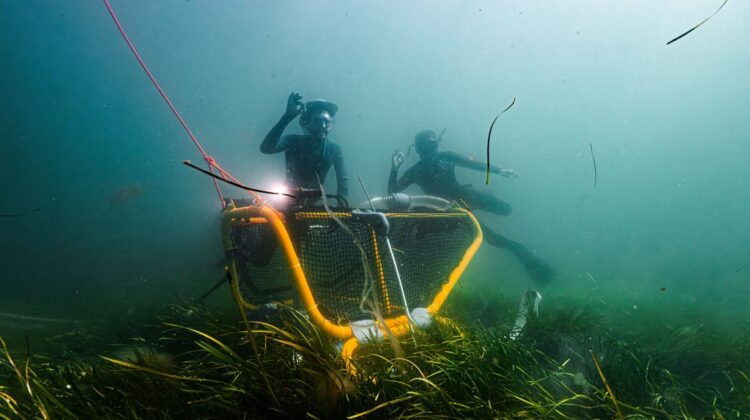
Conservation charity Project Seagrass and design company Tandem Ventures have joined forces to design, develop, build and test a new automated underwater harvester that will cut and collect seagrass seed pods.
This process – traditionally carried out manually by divers – is essential for restoring seagrass meadows, which sustain marine life, capture carbon, cushion coastlines from erosion and provide a safe nursery for countless species.
Advertisement

A harvester prototype, featuring a datalogging ‘brain’, was launched after several iterations in Porthdinllaen Bay in Wales, one of Britain’s most precious surviving seagrass meadows. The testing was limited to a short test harvest to prove the concept worked while causing minimal impact, with a handful of seed pods successfully collected by the new harvester pump-filter system.
‘The aim is to make harvesting seagrass seeds 100 times faster than the current methods, in which scuba divers collect them one by one manually,’ explained Sam Rogers, co-founder of Tandem Ventures. ‘Tests were promising, with a radically increased collection rate, and this has given us the confidence to go away and look at refining the prototype, including upgrading the pump. With seagrass restoration initiatives in operation worldwide, the team at Tandem hope the implications and learnings from these trials will have a global impact.’
Advertisement

The entire autonomous harvester was designed collaboratively in PTC’s Onshape, a cloud-native CAD and product data management platform. It enabled the team to collaborate seamlessly from anywhere – logging in from laptops on the road, in workshops and on boats.
Real-time version control, commenting and simultaneous editing allowed the Tandem design team to iterate rapidly and safely. According to the team, that flexibility proved crucial in what proved to be a fast-moving, experimental build where the design evolved daily between test sessions.
Advertisement
For custom parts such as hinges, leg joints, tube guides, fins and protective guards, the team partnered with Bambu Lab, using its H2D 3D printer, which is capable of building large, industrial-strength components in durable TPU and PLA materials.
The craft, which is roughly the size of a small car, was held together with a host of seaworthy, marine-grade stainless steel fasteners supplied by Accu Components, chosen to withstand the harsh saltwater environment.
At the heart of the harvester is a datalogging ‘brain’, components for which were supplied by Mouser Electronics. The system records depth, orientation, pressure, turbidity and temperature, providing vital feedback for researchers.
Advertisement
‘The seagrass-harvest project is a perfect showcase for how our software can help innovative organisations achieve success in demanding environments,’ said David Katzman, general manager of Onshape and Arena at PTC. ‘All of the features we’ve packed into Onshape are included to make design changes faster and in real time, with collaboration anywhere in the world one of the unique offers that accelerates iterations and gets products to market quicker.
‘After the initial trial, a flexible 3D-printed blade guard, heavy duty crank-handle adjustable legs and a host of robustness upgrades were also added to the craft,’ he continued. ‘We’ll continue to work with Tandem Ventures and Project Seagrass to further improve the prototype and, hopefully, create a faster, more efficient solution to keeping seagrass meadows alive in the future.’
Advertisement
Following the North Wales experiment, Tandem Ventures is working on a new pumping system to increase reliability and simplicity, using a vastly different pumping technique that looks somewhat like a sci-fi laser blaster.