
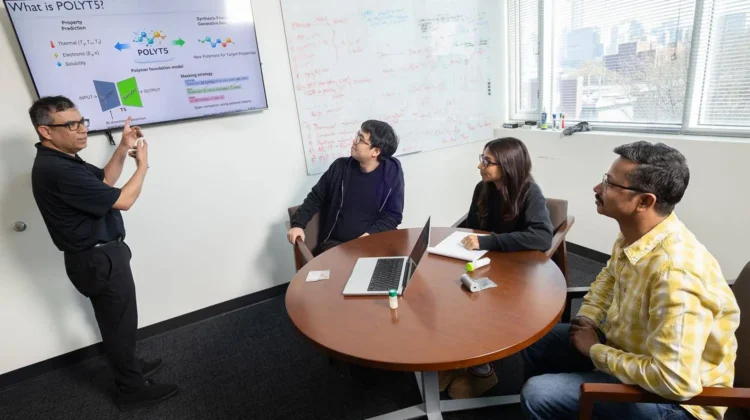
A team of materials scientists at Georgia Institute of Technology have created new generative artificial intelligence tools that are similar to Claude and ChatGPT but for designing new materials.
The words on this page mean something because they are assembled in a particular order and follow the complex rules of grammar and syntax. Creating new chemical polymers follows a similar kind of structure, with rules about which elements and groups of atoms go together and how to assemble them to make sense. This thinking is what led the scientists to create the new tools.
Advertisement

Using foundational models for generative polymer design that have been validated through physical experiments, the model will generate a chemical structure for a polymer based on properties specified by the user.
‘This architecture learns the chemical semantics and chemical grammar. It learns what is allowed, what is not allowed, what comes together well and what makes a good chemical sentence,” said Regents’ Entrepreneur Rampi Ramprasad, a professor in the School of Materials Science and Engineering. ‘A word is really defined by the neighbours it keeps. That’s the context for the meaning of a word. It’s the same with atoms or clusters of atoms.’
Advertisement

Called POLYT5, the tool overcomes barriers that have limited previous generative AI approaches to polymer design, which sometimes suggested polymers that failed to follow the rules of chemistry or couldn’t be created in real-world labs.
‘The chemical structures POLYT5 generates are 100 per cent robust and will follow chemical grammar and semantics,’ Ramprasad said. And because the model is trained only on polymers that can realistically be made, its ideas are more likely to be usable.
Advertisement
To create POLYT5 and a related tool called polyBART, Ramprasad, research scientist Harikrishna Sahu, postdoctoral scholar Wei Xiong and PhD students Anagha Savit and Shivank Shukla started with existing AI language architectures. They stripped out the natural language training and instead taught the model using polymer chemical structures – the words and sentences of chemical language. They used more than 12,000 experimentally produced polymers from research studies, plus a bank of more than 100 million hypothetical candidates.
To test the new models, the research team asked them to suggest designs for materials called polymer dielectrics, which are used in electric vehicles, defibrillators and other places requiring a quick burst of energy. The team outlined a series of specific properties that would result in good performance at high temperatures and allow the material to be processed industrially. The researchers picked one of the top candidates from each model’s output and created it in the lab. Their testing showed they performed just as expected.
Though Ramprasad and his team fine-tuned the base model for dielectrics in the study, the idea is that it can be tuned for any combination of properties. In fact, his group is doing exactly that, teaching the model to design polymers for very different uses as part of new projects underway in his lab.
Advertisement
The researchers also paired POLYT5 with a general-purpose large-language model. The goal is to make it possible for more scientists to use it without being experts in polymer design and creation. ‘We live in a world where people want to be able to converse with these agents, and we ultimately want to decrease the barrier for adoption of these tools,’ Ramprasad said.
POLYT5 and polyBART build on years of previous work in Ramprasad’s lab. His team has built tools to predict properties of potential polymers to speed discovery of new materials. The new model offers the inverse: using the desired properties to design the polymer from the beginning.
Advertisement
‘Language, they say, is the frontier of intelligence. And this is a different kind of language – the language these atoms follow,’ Ramprasad said. ‘I’ve worked in this field for a long time, but even five years ago, I would not have thought that language models could be adapted to learn chemistry.’
The research has been published in npj Artificial Intelligence.