
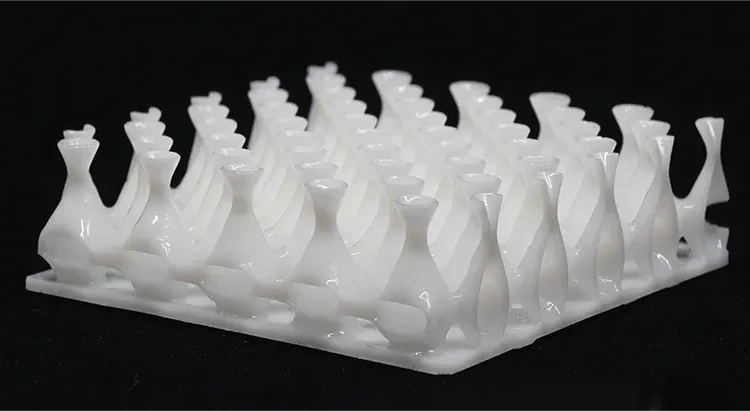
Researchers from Delft University of Technology in the Netherlands and ETH Zürich have developed an AI model – dubbed DiffuMeta – that works in a similar way to ChatGPT, but instead of generating text, it designs 3D materials. By representing shapes as mathematical sentences, the model can generate entirely new metamaterials that meet specific mechanical goals, such as how they bend, compress or absorb energy.
Designing a new material is one of the most challenging problems in engineering. This is especially true for metamaterials, where the geometry instead of the chemical composition determines its mechanical behaviour. Designing metamaterials with specific properties often requires exploring an enormous number of possible shapes. Just a decade ago, discovering a new metamaterial design could take up an entire PhD project. Artificial intelligence is now beginning to change that.
Advertisement

Previously, TU Delft associate professor Sid Kumar and his colleague, professor Dennis Kochmann from ETH Zürich, showed that AI can be highly effective at inverse design. Instead of starting with a structure and calculating its behaviour, inverse design starts with the desired properties and searches for structures that achieve them.
Now, they have taken this idea one step further. With DiffuMeta, they introduce a model inspired by large language models such as ChatGPT. Based on specific mechanical properties, it can generate entirely new metamaterials that have never been seen before.
Advertisement

One of the biggest challenges in applying AI to material design is that neural networks do not naturally understand geometry. ‘That’s why we turned geometries into mathematical equations,’ Kumar explained. ‘These elements act like our words and with the rules of mathematics as our grammar, we can form sentences that are understood by our AI model.’
The model uses a technique known as a diffusion process, similar to the technology behind AI image generators. When you ask an image model to create a picture, it starts with random noise and gradually refines it into a meaningful image. DiffuMeta works in much the same way, but with mathematical expressions instead of pixels. The final output is an equation that represents a 3D geometry.
Advertisement
Importantly, the model doesn’t produce just one solution. It generates multiple different designs that all meet the same criteria, giving engineers a range of options to choose from.
To test whether these designs actually work, the researchers moved beyond simulations. They 3D-printed several of the AI-generated metamaterials and tested them in the lab. The results showed that the physical samples behaved as predicted, matching the targeted stress-strain properties in this case.
DiffuMeta represents an important step toward a new way of designing materials, where engineers specify what they want and AI explores the vast design space for them. The researchers now aim to expand the model to other types of materials, such as polymers and piezoelectric systems.
Advertisement
Another key goal is to reduce the amount of training data required, making the method more efficient and widely applicable. ‘The long-term vision is ambitious: a single AI model that can design many different kinds of materials, across multiple properties and applications. If successful, this approach could fundamentally change how materials are created,’ Kumar concluded.
The research has been published in Nature Machine Intelligence.