
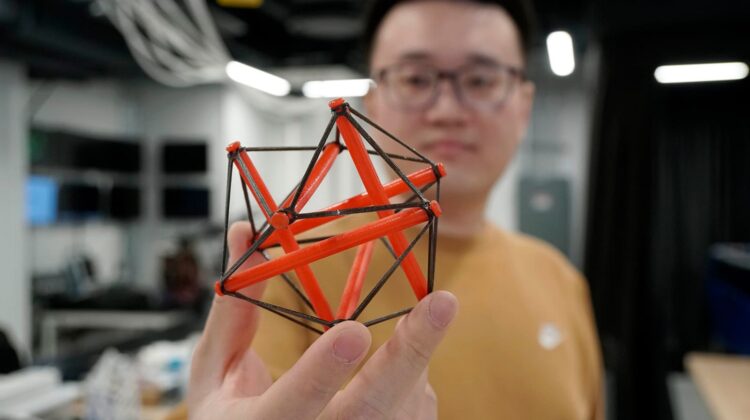
Researchers from Princeton University’s engineering school have developed a system that designers can use to mimic irregular natural structures such as termite mounds or human bones – not only their microstructural patterns, but their mechanical properties as well.
‘We created a theory that is applicable to two distinct physical systems,’ said Glaucio Paulino, the Margareta Engman Augustine Professor of Engineering at Princeton. ‘Knowing one such system can help to understand the other one better.’
The researchers developed the method by combining two disciplines: origami, which studies how surfaces fold along creases, and tensegrity, which explores structures held together by compression and tension. Origami is commonly used to create objects that fold into compact shapes and expand to deploy in areas such as space exploration. Tensegrity describes structures suchas the human skeleton, which holds its shape through a balanced distribution of stress among hard bones and soft tissues.
By exploring the mathematics that govern origami and tensegrity, the researchers learned that the systems’ underlying mathematical rules are essentially the same. Although not obvious to non-mathematicians, the formula governing origami’s precise folds can be translated into the rules that govern tensegrity’s force distribution.
Advertisement

‘It turns out that the same equation describes both engineering structures, origami and tensegrity,’ said Xiangxin Dang, a postdoctoral researcher at Princeton. ‘These two different types of structures are connected by math.’
Regular shapes, such as a cube or a sphere, are easy to design because they can be described by a small number of variables, Dang said. But irregular shapes, such as a termite mound or a complex section of bone, can demand many such variables to describe such disordered systems. This can make some designs impractical because these variables form large systems of equations demanding extensive analysis.
‘Without symmetry, the math appears far more complex,’ Dang said. ‘But we found a way to bypass that complexity when a non-symmetric system inherits properties from a symmetric one.’
Using their new theory, called the invariant dual mechanics of tensegrity and origami, the researchers can start with a symmetric structure with known mechanical properties, such as stability or flexibility, and transform it into a non-symmetric form. The invariance (a mathematical term for an element that doesn’t change during an operation) allows them to determine the same properties for the new structure, without having to perform complex calculations on the new form.
The researchers said while the application works for design, it can also work for optimisation, in which engineers fine tune specific properties from a group of designs. Using the invariant duality, the engineers could easily try out new versions of stable or flexible structures without relying on trial and error, which would require complex calculations for each new shape. Instead, the engineers could start with a regular shape and adjust it as needed.
Advertisement
For example, consider a car designer looking for an efficient chassis design. Using older methods, the designer would have to repeatedly model the design and calculate the aerodynamics for each version. If a similar invariant method could be established, then the designer could start with a simple shape and tweak it to improve airflow.
Dang said that early work on coupling the mathematics behind force and motion was performed several decades ago as part of a branch of mathematics called rigidity theory. But he said the work hadn’t been pursued in a significant way. Researchers in Paulino’s lab, who often apply abstract mathematical concepts to engineering applications, wanted to know if they could develop applications by interpreting the mathematics through origami and tensegrity.
‘We wanted to explore the problem in a way that could lead to engineering solutions,’ Dang said.
Dang said that the mathematics can be applied to areas including robotics, which often involves irregular components, and metamaterials, in which the geometry of a material has a direct impact on its properties.
The research has been published in the Proceedings of the National Academy of Sciences.