
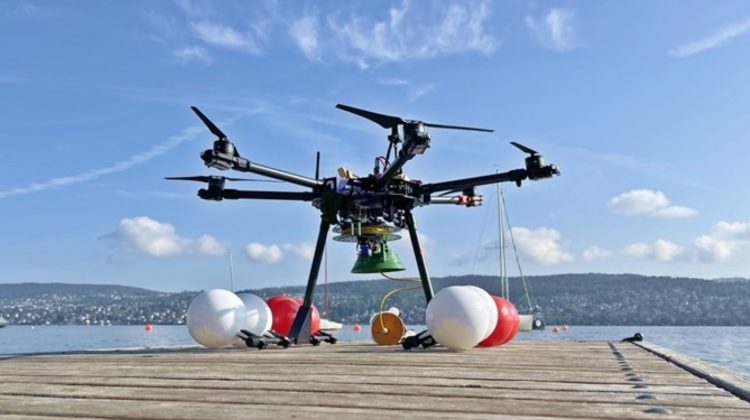
Researchers at Imperial College London have developed a ‘dual robot’ drone that can be used to measure water in lakes for signs of microorganisms and algal blooms, and could potentially be used to monitor climate clues such as temperature changes in Arctic seas.
The researchers developed the drone in order to boost our ability to rapidly monitor aquatic environments. The unique design, dubbed Multi-Environment Dual robot for Underwater Sample Acquisition (MEDUSA), could also help to monitor and maintain offshore infrastructure such as underwater energy pipelines and floating wind turbines.
Advertisement

‘MEDUSA is unique in its dual-robot design, with a flight component that reaches difficult-to-access areas and a diving component that monitors water quality,’ said Professor Mirko Kovac, director of the Aerial Robotics Lab at Imperial. ‘Our drone considerably simplifies robotic underwater monitoring by performing challenging tasks that would otherwise require boats.’
The drone flies using remotely controlled multi-rotors – lift-generating blades that rotate around a central vertical mast like helicopter blades. Using multi-rotors means that MEDUSA can travel long distances with large payloads, fly over obstacles and manoeuvre through difficult terrain.
Advertisement

After flying to a difficult-to-reach aquatic environment, the drone lands on the water and deploys its tethered mobile underwater pod, which features a camera and sensors and can descend to depths of up to ten metres.The drone operator remotely adjusts the pod’s depth and three-dimensional position in the water using buoyancy control and jets. All the while, the user is guided by real-time video and sensor feedback from the pod.Once samples have been taken, the drone coils up its tether and reunites with the pod before taking off and flying back to the operator.
While the underwater pod design is new, the aerial drone design is an industry standard, meaning that MEDUSA systems can be easily constructed and deployed using industrial operational frameworks.
Advertisement
Ecologists typically use boats to reach and monitor aquatic areas, but MEDUSA could help to reduce the risk to humans of travelling to difficult-to-reach aquatic environments. This could be particularly useful in the Arctic Ocean, where changes in ocean temperatures, acidity, salinity and currents can offer critical clues about the global climate crisis.
‘We have much to learn from the Earth’s water,’ Kovac said. ‘By monitoring ecological parameters, we can identify trends and understand the factors that affect water quality and the health of the ecosystem in a changing climate. MEDUSA’s unique ability to reach difficult places and collect aquatic images, samples and metrics will be invaluable for ecological and aquatic research, and could support our understanding of local climate in difficult-to-access environments such the Arctic.’