
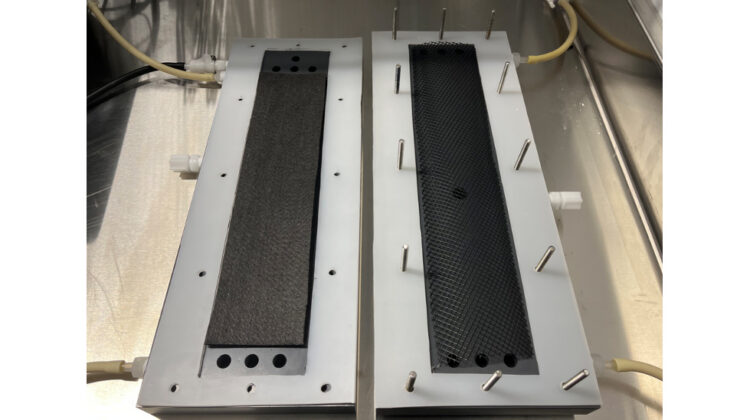
An international team led by researchers at Pennsylvania State University has developed a new reactor design that efficiently converts carbon dioxide and renewable electricity into methane – the primary component of natural gas – while scaling the system up by roughly an order of magnitude without sacrificing performance. The study demonstrated that microbial electrosynthesis systems can be expanded beyond laboratory-scale devices while maintaining high energy efficiency and methane production rates.
The research addresses a central challenge in renewable energy: how to store energy over long periods of time. ‘Traditionally, large-scale, long-term storage means pumping water uphill and letting it flow back down through turbines,’ said Bruce Logan, director of Penn State’s Institute of Energy and the Environment. ‘If you’re talking seasonal storage, you really need to put that energy into a chemical form.’
In this system, electricity from renewable sources such as solar or wind is used to split water and generate hydrogen. Microorganisms, known as methanogens, then use that hydrogen to convert carbon dioxide into methane, a fuel that can be stored and transported using existing infrastructure.
‘The big picture is that we can use low-cost renewable electricity to make methane that can go into existing storage and pipeline systems,’ said Logan, Evan Pugh university professor and Kappe professor of environmental engineering in Penn State’s Department of Civil and Environmental Engineering.
Advertisement

Microbial electrosynthesis has long been limited by low efficiency and challenges in scaling beyond small devices. In this study, the researchers focused on reactor design to address those constraints. They developed an up-scaled ‘zero-gap’ reactor, where electrodes are separated only by a membrane. This configuration minimises internal resistance and improves energy efficiency.
The new system increased electrode area by about tenfold and extended the flow path to 30 centimetres. Despite the larger size, the reactor maintained strong performance. ‘Even though we made the system much bigger, the internal resistance didn’t get worse,’ Logan said. ‘That’s because we were able to use the hydrogen coming off the electrodes much more efficiently.’
The reactor also incorporates multiple flow ports to distribute fluids and gases more evenly, helping maintain consistent conditions throughout the system.
In laboratory tests at 30°C the system produced up to 6.9 litres of methane per litre of reactor volume per day. The reactor achieved coulombic efficiencies above 95 per cent, meaning most of the electrical input was converted into methane rather than byproducts.
Energy efficiency reached about 45 per cent, placing it among the highest reported for microbial electrosynthesis systems under standard conditions, according to Logan. ‘We’re taking electricity and turning it into methane at an efficiency on the order of 45 per cent to 47 per cent,’ Logan said. ‘Starting from carbon dioxide and electrons and upgrading that into methane – that’s pretty good.’
Advertisement
The study also clarified how methane is produced in the system. Rather than relying on microbes to directly take electrons from an electrode – a process that produces relatively low output – the reactor generates hydrogen, which microorganisms rapidly consume to produce methane. ‘We split water to make hydrogen, and the methanogens are right there to use it immediately,’ Logan said. ‘You can think of it as a water electrolyser, which uses electricity to split water into hydrogen and oxygen, combined with a biological system.’
This hydrogen-mediated pathway allows for higher current densities and faster methane production compared to earlier approaches.
The findings suggest that microbial electrosynthesis systems can be scaled up effectively if reactor design supports efficient transport of hydrogen and stable microbial activity.
Logan said future systems could be paired directly with renewable energy sources. ‘I see methane-generation plants built next to solar or wind farms,’ he said. ‘Instead of putting electricity onto the grid, you use it on site to produce methane and inject that into gas lines.’
Such systems could provide long-duration energy storage while reusing carbon dioxide and leveraging existing natural gas infrastructure, he explained.
The researchers noted that economic viability will depend largely on access to low-cost renewable electricity, as well as continued improvements in catalyst materials and reactor design. They also highlighted the importance of minimising methane leakage, which could offset climate benefits if not carefully controlled.
Still, the concept offers a potential pathway for converting carbon dioxide into a storable, transportable fuel, Logan said. ‘We don’t need to dig methane out of the ground,’ Logan said. ‘We can use carbon dioxide we’re already producing and turn it into something useful.’
The research has been published in Water Research.