
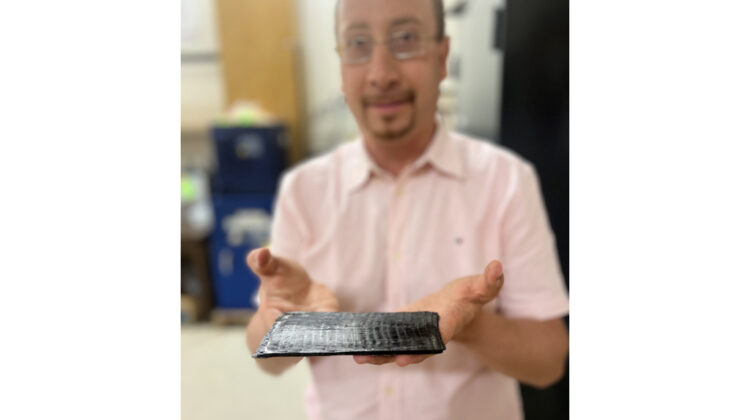
Aerospace engineering and materials science researchers at Texas A&M University have uncovered new properties of an ultra-durable, recyclable, smart plastic – paving the way for transformative applications in the defence, aerospace and automotive industries.
The breakthrough was led by Mohammad Naraghi, director of the Nanostructured Materials Lab and professor of aerospace engineering at Texas A&M, in close collaboration with Andreas Polycarpou at the University of Tulsa.
‘What’s really exciting is that this material isn’t just ultra-durable – it’s also adaptive. From on-demand healing in damaged aircraft to enhancing passenger safety in vehicles, these properties make it incredibly valuable for future materials and design innovations,’ Naraghi said.
Their work explored the mechanical integrity and shape-recovery and self-healing properties of an advanced carbon-fibre plastic composite called aromatic thermosetting copolyester (ATSP). ATSP opens new frontiers in industries where performance and reliability are critical and failure isn’t an option.
Advertisement

‘In aerospace applications, materials face extreme stress and high temperatures,’ Naraghi said. ‘If any of these elements damage any part of an airplane and disrupt one of their main applications, then you could perform on-demand self-healing.’
As ATSP matures and scales, it holds the potential to transform commercial and consumer industries, particularly the automotive sector. ‘Because of the bond exchanges that take place in the material, you can restore a car’s deformations after a collision, and most importantly, significantly improve vehicle safety by protecting the passenger,’ Naraghi said.
ATSP is also a more sustainable alternative to traditional plastics. Its recyclability makes the material an ideal candidate for industries aiming to reduce environmental waste without compromising durability or strength. ‘These vitrimers, when reinforced with discontinuous fibres, can undergo level cycling – you can easily crush and mould it into a new shape, and this can happen across many, many cycles, and the chemistry of the material basically doesn’t degrade,’ Naraghi said.
‘ATSPs are an emerging class of vitrimers that combine the best features of traditional plastics,’ Naraghi said. ‘They offer the flexibility of thermoplastics with the chemical and structural stability of thermosets. So, when combined with strong carbon fibres, you get a material that is several times stronger than steel, yet lighter than aluminium.’
What sets ATSP apart from traditional plastics is its self-healing and shape-recovery capabilities.
Advertisement
‘Shape recovery and self-healing are two facets of the same mechanism,’ Naraghi explained. ‘With shape recovery, it refers to the bond exchange within a continuous piece of material – a kind of built-in “intelligence”. And, in self-healing, there’s discontinuity in the material like a crack. These are the properties we investigated.’
To investigate its properties, the researchers used a novel stress test called cyclical creep testing. ‘We applied repeated cycles of tensile, or stretching, loads to our samples, monitoring changes in how the material accumulated, stored and released strain energy,’ Naraghi said.

Using cyclical loading, the researchers identified two critical temperatures within the material.
‘The first is the glass transition temperature, or the temperature at which the polymer chains can move around easily, and the second is the vitrification temperature. That’s the temperature at which these bonds are thermally activated enough that you can see massive bond exchanges to cause healing, reshaping and recovery,’ Naraghi said.
The team then conducted deep-cycle bending fatigue tests, periodically heating the material to around 160°C to trigger self-healing. Their results showed that the ATSP samples not only endured hundreds of stress and heating cycles without failure, but that they actually grew more durable during the healing process.
‘Much like skin can stretch, heal and return to its original shape, the material deformed, healed and “remembered” its original shape, becoming more durable than when it was originally made,’ Naraghi said.
Naraghi and his team put the heat-resistant ATSP through five gruelling stress cycles, each followed by high temperature exposure at 280°C. After two full damage-healing cycles, the material returned to nearly full strength. By the fifth cycle, healing efficiency dropped to about 80 per cent because of mechanical fatigue.
‘Using high-resolution imaging, we observed that the composite after damage and healing was similar to the original design, though repeated damage caused some localised mechanical wear attributed to manufacturing defects,’ Naraghi said.
Still, the material’s chemical stability and self-healing behaviours remained reliable across all five cycles. ‘We also observed that there was no thermal degradation or breakdown in the material, demonstrating its durability even after damage and healing,’ Naraghi said.
The research has been published in Macromolecules and the Journal of Composite Materials.