

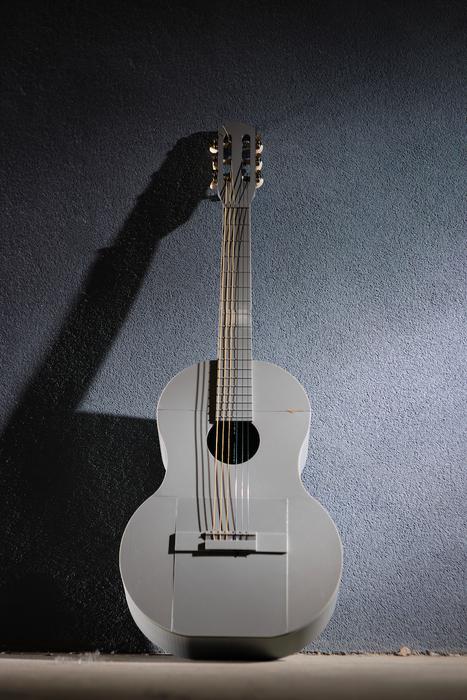
A mechanical engineering student at Binghamton University, State University of New York, has created a playable 3D-printed acoustic guitar. Unlike a traditional instrument, it’s made out of thermoplastic filament, but it works.
‘It wasn’t something that people had really looked into,’ Timothy Tran (pictured above) said. ‘People have made 3D-printed electric guitars – that’s probably easier because you don’t have to worry about the vibrations as much. I just wanted to try something new.’
Advertisement

A guitarist since his senior year of high school, Tran was looking for ways to apply his engineering skills over summer break when he stumbled upon his dad’s old guitar up in the attic. Unfortunately, it was no longer playable, but Tim saw an opportunity.
‘I saw it broke and I said, “I can make a new one for you,”’ Tran said. ‘I decided it would be a good thing to just try.’
Advertisement

With that goal in mind, Tran started designing a prototype based on his father’s guitar and sought out assistance from William E Schiesser (pictured below, at left), a lecturer at the School of Computing. The project ‘struck a chord’ with Schiesser.

‘I just kind of pointed in the right direction and gave him some guidance,’ Schiesser said. ‘We’ve met every week since the beginning of the summer, and he’s really done some great work with us.’
Advertisement
Tran’s design process took time and patience. He painstakingly measured the dimensions of his father’s vintage guitar, a process that took a couple of weeks to get right. ‘Design work is key,’ Schiesser said. ‘You have to do a lot of planning up front to make sure all the parts fit together.’
Once the design was in place, Tran modelled the guitar in Fusion 360 design software and printed it on a Prusa MK4 3D printer. Because the printer was only 25 centimetres by 25 centimetres, pieces that normally would be a single unit had to be split up. For example, the fretboard was divided into two pieces.
Unlike a traditionally constructed guitar, the pieces fit together using a press-fit method. A special connecting plate allows the different pieces to slide together. ‘Putting it together was pretty easy. It only took one or two days. It was more just waiting for the glue to dry,’ Tran said. ‘The longest part was probably just waiting for parts to print. Bigger pieces might take six or seven hours to print.’
Advertisement
Tran can play some classical pieces such as Pachelbel’s Canon, scales and a few funky licks, but the guitar isn’t quite stage-ready. The action (that’s how far the strings sit above the neck of the guitar) is a bit too high, and the guitar is hard to keep in tune. Tran and Schiesser are developing a second prototype to work out the kinks.
‘I’m just trying to figure out a way to make the neck piece a little more uniform and how to get the action lower,’ Tran said. ‘Just to get it to a more playable feel, because right now this is pretty tough to play. It doesn’t feel that comfortable.’
Advertisement
‘It’s an iterative process. You make one prototype, see how it works, then correct any issues,’ Schiesser added.
Tran’s father was excited about the project, regularly asking him for updates on when a new part was being made or which stage he had reached in the design process. ‘Once I finished it, I gave it to him first, and he was overjoyed to play it; he texted all his siblings bragging about it!’ Tran said.
Tran and Schiesser hope that the design can be made accessible to people around the world who can’t afford to spend big bucks on an instrument. One of Tran’s guitars costs just US$25-30 to print, which includes the price of one and a half rolls of filament, strings and tuning pegs.
‘If it were to become something really successful, I want it to be just something that can be free access for everyone,’ Tran said. ‘Growing up, we didn’t have that much money… so if it’s just something that’s easy and accessible for people who need it, I think that’d be really cool.’
Schiesser, who has a background in patents and intellectual property law, said that the design could be like an ‘open-source guitar’. ‘Just like we share software and code by open source with license, this could be posted online, and anybody could access the design for free, as long as they have access to a 3D printer and can get it printed out,’ Schiesser said.
Tran, who will intern at GE Aerospace in spring 2026, wants to work on vehicles and engines once he graduates. But he’s not ruling out a gig in the guitar industry. Whatever happens, he’s happy that he was able to use his interest in engineering and apply it to another field that he’s passionate about.
‘It was good to put it out into the world,’ Tran said. ‘It’s just a good way to direct what I wanted to do, because I had a lot of ideas, but I didn’t really know how to employ them. It was just really cool to see an idea I had just really come to life.’