
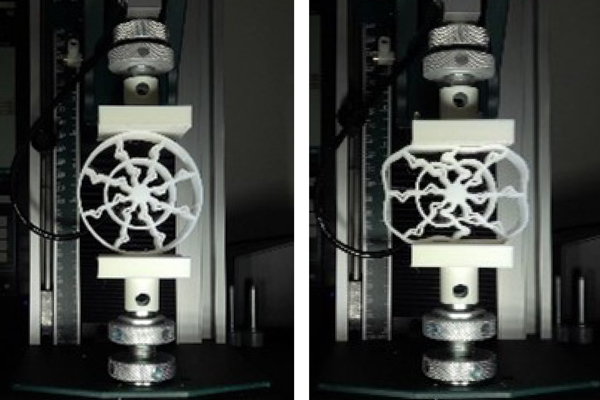
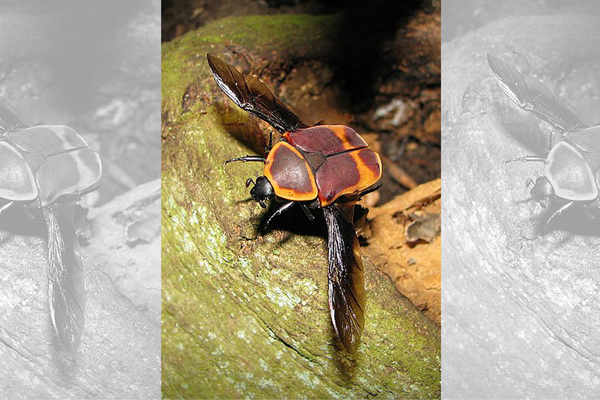
A team of London South Bank University engineers has used insights gained from the way in which a unique beetle wing changes shape during flight to develop a new one-way hinge design.
The hindwings of sun beetles (Pachnoda marginata) have an unusual bell-shaped structure that is compliant in one direction, but almost ten times stiffer in the opposite direction. The wing hastwo distinguishable layers – a bell-shaped upper layer and a nearly straight lower layer – that mean that the wing is stiff in tension and upward bending, but flexible in compression and downward bending.
Advertisement

The researchers mimicked the wing structure to produce a one-way hinge that could have applications over a wide variety of sizes and in a number of industries, including a modular design that can easily be assembled and disassembled, as a design for adaptive airless tires and as metamaterials with zero Poisson’s ratio – that is, it doesn’t deform along its length when stretched.
‘By systematically varying its design parameters in a computational model, we showed that the properties of the double-layer membrane hinge can be tuned over a wide range,’ said Hamed Rajabi, a lecturer in mechanical engineering and design in the university’s School of Engineering. ‘This enabled us to develop a broad design space, which we later used for model selection. We used selected models in three distinct applications, which proved that the double-layer hinge represents a simple, yet effective, design strategy for controlling the mechanical response of structures using a single material and with no extra mass.
Advertisement

‘This biological one-way hinge offers biometric inspiration for the design and development of engineering structures that exhibit asymmetric responses to equal forces applied in different directions,’ Rajabi concluded. ‘This is particularly interesting because the double-layer membrane offers a simple, inexpensive way of making a one-way hinge without increasing the mass.’
The research has been published in the Proceedings of the National Academy of Sciences.