
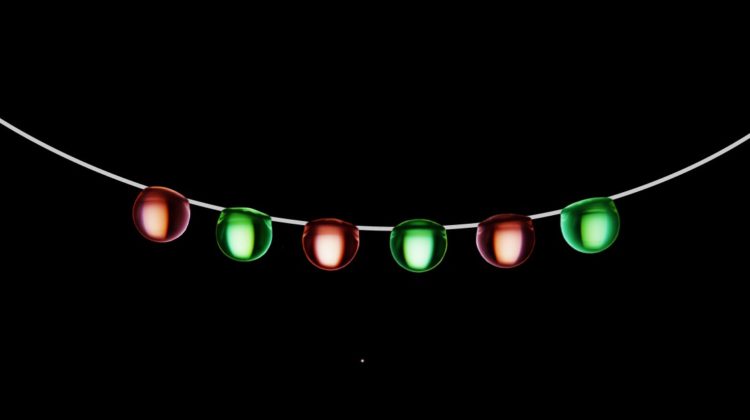
New research about the way in which water droplets behave, carried out by engineers at Northwestern University in Illinois, could help to optimise several environmental processes, including collecting fog from the atmosphere for drinking water.
The image may look like a festive, holiday-inspired necklace, but it’s actually colourful water droplets clinging to a wire. Because the wire is engineered to attract water, the droplets glide along the line, eventually merging into one another.
Advertisement

When the water-attracting wire is inclined, the droplets zip along the line. When two water droplets slide into one another and coalesce, the larger droplet’s speed is up to 270 per cent faster.
According to Kyoo-Chul Kenneth Park, an assistant professor of mechanical engineering in Northwestern’s McCormick School of Engineering, the insights that he and his team have gained into coalescence-induced propulsion of droplets on extremely hydrophilic wires will enable them to optimise the ability to harvest fog from the atmosphere.
Advertisement

As water scarcity becomes an increasing problem around the world, fog harvesters have emerged as an inexpensive and accessible way to collect drinkable water. However, they are inefficient, with water droplets often escaping through the mesh harvesting sheets. Park’s work could lead to new, more efficient designs for harvesters that outperform currently available meshes.
The findings also have implications for mist elimination, oil/water separation, microplastics remediation and even biomedical filters.
Advertisement
‘The new phenomenon and mechanism about the sudden increase of droplet speed along a super-hydrophilic wire will benefit various fields,’ Park said. ‘This includes biomedical research requiring a fast transport of liquid, such as masks and filters, to protect people from airborne microplastics and droplets containing viruses.’
The research has been published in Applied Physics Letters.