
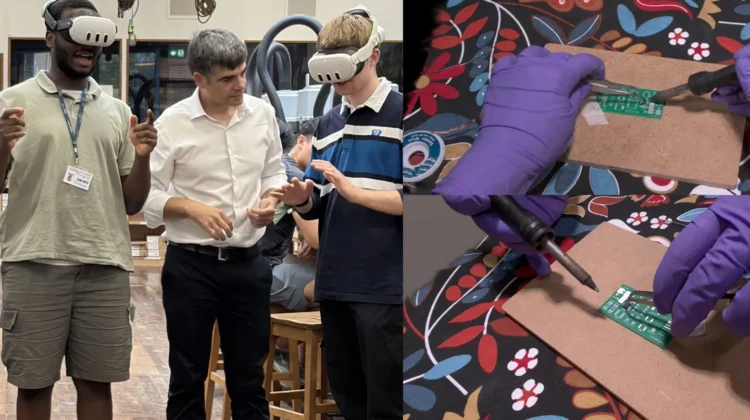
Learning to solder means watching closely: where the iron touches, how the solder flows and when to move your hands. But in a crowded teaching laboratory, that view can be difficult to get. Imperial College London has worked with immersive video specialist Gracia AI to create a masterclass that lets engineering students examine an expert’s technique from different angles.
The recordings allow viewers to move around a three-dimensional scene as the demonstration plays, using either a VR headset or a conventional screen. Students can look closely at the demonstrator’s hands, tools and circuit board, choosing a viewpoint that helps them understand each operation.
‘Demonstrating to a large group is tricky because only students standing close can see what you’re doing,’ said Dr Adrià Junyent-Ferré, Associate Professor in Power Electronics at Imperial. ‘We tried regular video recordings, but they never quite worked because of the poor depth perception.’
The masterclass uses a technique called 4D Gaussian Splatting to reconstruct footage from multiple cameras into a moving three-dimensional scene. Capturing soldering required the team to rethink its usual setup: at AdventuryXR’s London studio, 44 cameras were arranged in a compact dome above a table to record Electronics Laboratory Technician May Tang’s demonstrations.
Advertisement
Some cameras captured the wider scene, while others focused closely on her hands and the circuit board. May worked with her arms extended to keep the tools and solder joints visible, and Gracia adapted its processing to preserve small details alongside the complete scene. The finished recordings show markings above the solder pads and even fumes rising as the iron touches a joint.
An introductory scene and 13 short videos cover core operations, including soldering and desoldering surface-mount and through-hole components. Voice-over instructions from PhD student Tanmay Lad guide learners through each step, with the material designed to support a cycle of watching, pausing and practising at the bench.
Imperial undergraduates tried the experience during the summer, and the department’s September announcement set out plans to introduce it to smaller groups of incoming first-year students. That initial rollout will help the teaching team understand how to integrate the recordings into practical lessons before considering wider use. Future videos could also demonstrate common mistakes and their consequences.