
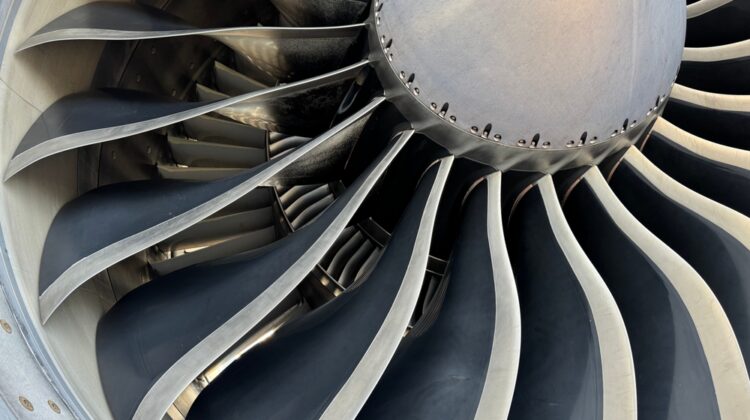
Running an aircraft engine hotter can help get more useful power from its fuel. Making components that can withstand those temperatures is one challenge. Shaping them accurately without causing damage is another.
A UK engineering consortium has demonstrated a manufacturing route that tackles both, producing and precision-finishing a ceramic matrix composite (CMC) aerofoil: a curved blade component that manages airflow inside an engine.
Coating specialist Archer Technicoat Limited (ATL) worked with the University of Sheffield’s Advanced Manufacturing Research Centre (AMRC) and the Manufacturing Technology Centre (MTC). Both research centres form part of the High Value Manufacturing Catapult.
Silicon carbide CMCs offer an alternative to the nickel-based superalloys used in demanding engine environments. According to the consortium, these composites can operate at temperatures approaching 1,650°C, compared with around 1,000°C for traditional nickel-based superalloys, while reducing cooling requirements.
Advertisement

But heat resistance alone does not make a usable component. These ceramics are brittle, making machining a delicate business. The finished part needs accurately shaped aerodynamic surfaces and fastening features, without structural damage introduced during manufacture.
The project brought together three stages of production. First, ATL used chemical vapour infiltration to turn woven silicon carbide fibres into a solid aerofoil. A specialised graphite mould was developed with the German Aerospace Center.
Next, MTC used laser cutting to trim away surplus composite material, avoiding the tool wear associated with mechanical cutting.
Finally, AMRC combined computer-controlled abrasive grinding with precision measurement and modelling to finish the curved surfaces. Small-diameter core drills produced the fastening features without causing structural failure.
Together, the processes established a complete manufacturing route, taking the capability to technology readiness level five. That marks a development milestone, rather than a component ready for service in an aircraft engine.
Advertisement
The work also demonstrated that rapid laser trimming and precision grinding can complement each other, providing a basis for future commercial production lines.
For UK manufacturers, the opportunity extends beyond aerospace. Establishing the ability to make and finish components for extreme temperatures could also support nuclear and defence applications, while building domestic expertise in materials that remain challenging to turn into reliable, accurately manufactured parts.