
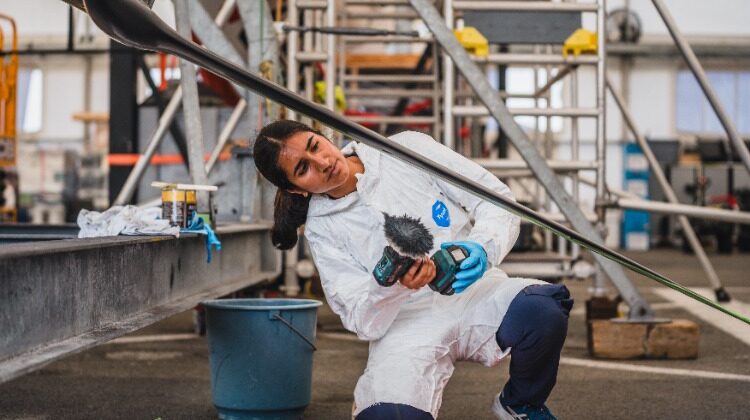
The performance of a foiling race boat depends on more than the design on a computer screen. Preparing and finishing its surfaces is hands-on work, where attention to detail can make a difference on the water.
University of Nottingham engineering student Aleeza Shaikh experienced that connection during a two-week placement with the Cobham-Ultra GB2 Women and Youth British America’s Cup team in Naples.
Working alongside the shore crew, Shaikh helped prepare the team’s AC40 foiling race boat, including wet sanding and finishing the surfaces of its foils. The placement gave her an opportunity to apply her studies in a demanding environment and explore an engineering career she had not previously considered.
The internship took place during the summer through the Athena Pathway, with support from Cobham-Ultra. Details were shared to mark National Engineering Day on 4 November.
Advertisement

‘Before I undertook this internship, I didn’t have any idea of how the industry truly worked,’ Shaikh said. ‘Getting the foils really sharp and clean, then seeing that translate into speed on the water, was amazing.’
Foils generate the lift that allows these boats to rise above the water. Their preparation brings together the design of the component and the practical work needed to get it ready for racing.
For Shaikh, joining the shore crew meant contributing to that process rather than simply observing it. She also went out on the team’s chase boat, seeing the AC40 in operation and gaining a different perspective on the equipment she had helped prepare.
That link between a task in the boatyard and performance on the water was central to the experience. It showed how engineering knowledge is applied through preparation, teamwork and the careful execution of practical work.
The programme aims to give young people a clearer understanding of engineering careers and help them take their first steps into industry. In Shaikh’s case, it opened up a sector that had not previously featured in her plans.
Advertisement
‘I am so thankful to Cobham-Ultra for providing this opportunity, as it has completely changed my perspective on jobs and how engineering can be applied,’ she said.
The placement also included a two-day outreach experience, during which Shaikh shared her route into engineering with young people considering careers in science, technology, engineering and mathematics.
For engineering education, the value of placements like this lies in connecting academic learning with the practical demands of a working team. Students can discover how their skills contribute, learn from experienced colleagues and explore opportunities beyond the industries they already know.
For Shaikh, two weeks in a boatyard provided that connection—and a new direction to consider for her engineering career.