
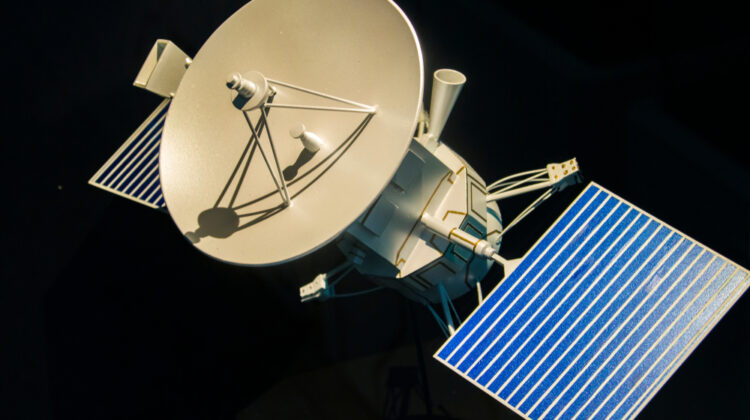
An aerospace PhD student and his advisor in the Grainger College of Engineering at the University of Illinois Urbana-Champaign have developed a creative and efficient energy-saving method to morph 2D structures into curved 3D structures while in space as a way of reducing the cost and difficulty of transporting large structures such as satellite dishes into space.
According to the student, Ivan Wu, what others have done using low energy resulted in shapes with very low stiffness that wouldn’t work for aerospace purposes. ‘In this case, our collaborators in the Beckman Institute developed a recipe for a pure resin system that’s very energy efficient,’ he said. ‘And we have a 3D printer that can print commercial aerospace-grade composite structures. I think the breakthrough was combining those two things into one.
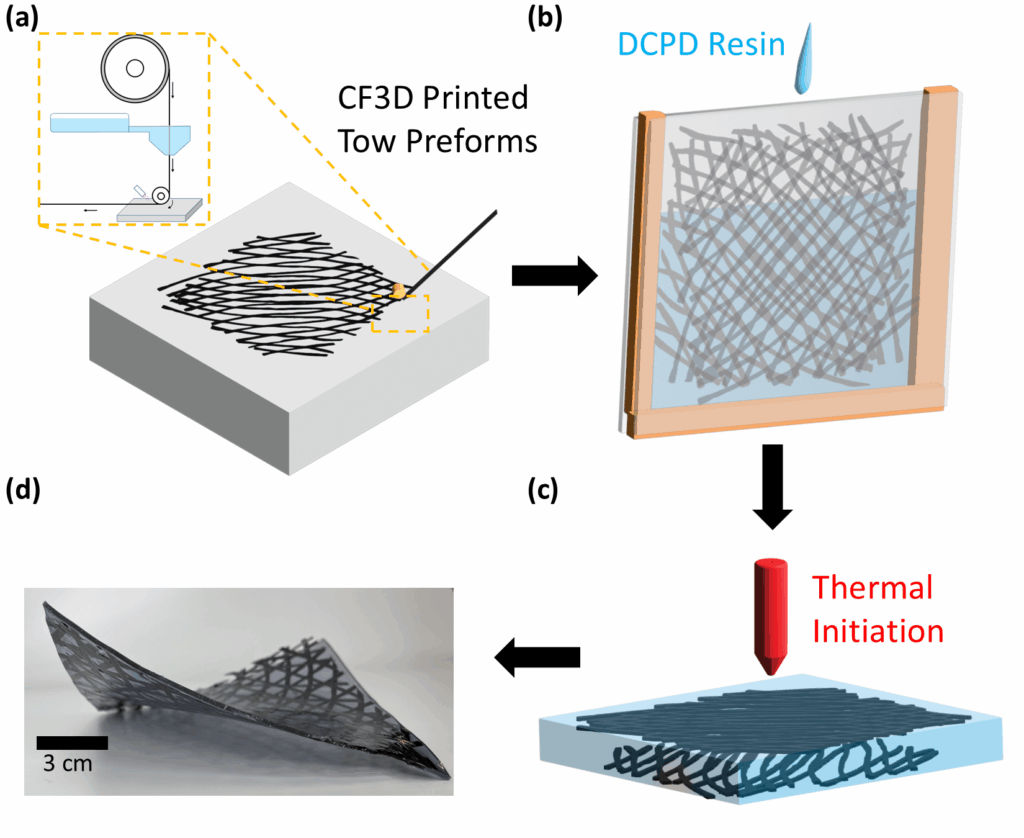
‘We used the continuous carbon fibre 3D printer to print bundles of fibre, with each fibre about the diameter of a human hair,’ he continued. ‘As the fibre bundles are drawn by the printer onto a bed, they are compressed and exposed to ultraviolet light, which partially cures them.’
Advertisement

The energy efficient liquid resin is moulded with the printed carbon fibre design then frozen. When the 3D structure is needed, the resin is activated with a low-energy heat stimulus that sets in motion a chemical reaction to cure it into a curved 3D shape.
This process, called frontal polymerisation, eliminates the need for ovens or autoclaves large enough to cure a full-sized satellite dish. Much like a single match can set a sheet of paper or a house on fire, the thermal trigger is the same amount of energy for any size structure, making the process scalable for extra-large structures needed in space.
‘For me, the first challenge was to solve the inverse problem,’ Wu said. ‘You have a design for the 3D shape you want, but what is the 2D pattern to print that results in that shape? I had to write mathematical equations to describe the shapes to print the exact pattern. This study solved that problem.’
Wu sourced equations and wrote the code to program the printer to deposit the fibre bundles onto a bed to create five different 3D configurations: a spiral cylinder, a twist, a cone, a saddle and a parabolic dish. ‘Together, they show the diversity of shapes we can make,’ he said. ‘But I think the one that’s most interesting and applicable is the parabolic dish, which mimics the smooth, curved shape that’s needed for deployable satellites.’
Wu said he took inspiration from a Japanese art form called kirigami – similar to origami but includes cuts in addition to folds. ‘I see research as very artistic,’ he said. ‘Sometimes, you get a creative idea and just pursue it. In this case, the parabolic shape begins in 2D with cuts like flower petals that all curve toward the same point. I had to figure out the angles where they overlap. A satellite dish made with just origami folds would need an infinite number of folds to make the smooth curvature required for satellite signals. In our case, rather than using folds, we achieve smooth curvature through controlled bending governed by the printed fibre bundles.’
Advertisement
Because the shape needs to morph, Wu’s fibre infrastructure needed a very low fibre volume fraction. ‘Space structures need to be very stiff, and the more fibre volume, the stiffer the structure. But they need a lot of energy to morph and could break with large bending. To get a high-morphing degree, we need a low fibre volume ratio so it will be flexible enough to morph into a curved shape.’
The study achieved both lower energy and higher stiffness compared to what has been done before. But Wu said the stiffness is still not adequate for space structures. ‘We suggest using the activated 3D shapes as moulds to manufacture high stiffness structures in space. You could manufacture the flat gel material with carbon fibre bundles on Earth, transport it into space and activate the shape through a thermal stimulus. But because it’s not rigid enough, you can further use the 3D shape as a mould, adding high-stiffness plies, activate frontal polymerisation again and then peel off the high-stiffness composite that is formed to the shape of the initial design. We show in our work that this process can be repeated numerous times without damage to the mould or deviation from the initial morphed shape.’
Wu said these same materials and processes could be used to supply needed structures to remote environments on Earth as well.
The research has been published in Additive Manufacturing.