
Engineers at Imperial College London have identified a hidden problem in AI-assisted design that could cause automated optimisation systems to overlook promising aircraft and spacecraft concepts.
The researchers found that engineering models can appear accurate when assessed individually, and even perform convincingly when coupled with other models, while still directing an automated design process away from better-performing solutions.
The team has called the phenomenon the ‘Modelling Adequacy Paradox’.
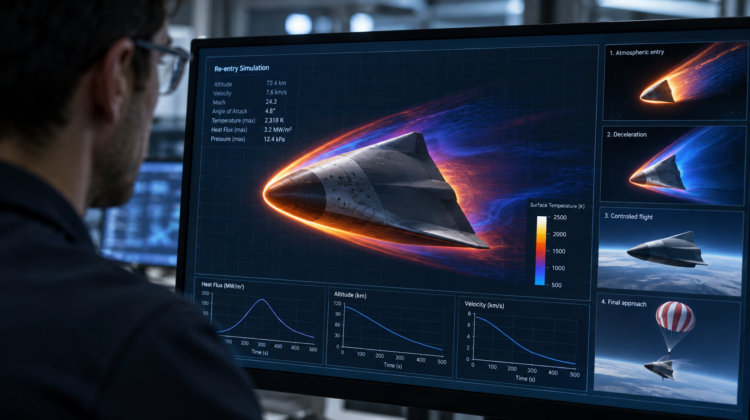
The discovery emerged from computational experiments examining the design of re-entry space vehicles, carried out by researchers in Imperial’s Department of Aeronautics.
Advertisement

Engineers increasingly use computational optimisation to explore large design spaces containing thousands of potential configurations. During the early stages of development, relatively simple models are commonly used because running detailed simulations for every possible design would require significant computing resources and time.
However, when the Imperial researchers compared conventional fixed-fidelity modelling with more advanced multifidelity methods, they discovered that the best-performing design occupied an area of the design space that conventional models had repeatedly dismissed.
As a result, the optimisation process never explored it.
‘What surprised us was not that simplified models can be less accurate, which is already well known, but that models can appear fit for purpose for an individual discipline and even when coupled with others, while still steering the design search away from better solutions,’ said Professor Laura Mainini, Chair in Aerospace Computational Design at Imperial.
The problem could become increasingly significant as AI and automated optimisation play a larger role in engineering.
Advertisement
Such systems can rapidly assess thousands of possible designs, but their results remain dependent on the models and assumptions supplying their information. An apparently reliable model could therefore reshape the design space being explored and cause potentially valuable concepts to be rejected before engineers analyse them using higher-fidelity methods.
The researchers argue that this presents a particular challenge for emerging aerospace technologies, including net-zero aircraft, where unconventional combinations of propulsion, structures, energy storage, software and control systems may be required.
Rather than relying on simplified models during early development before progressing to more detailed simulations, the researchers propose using ‘multifidelity’ and ‘multi-source’ optimisation.
This would introduce information from models with different levels of fidelity at selected points throughout the design process, allowing engineers to test whether lower-cost models are inadvertently hiding potentially useful solutions.
The approach could ultimately help engineers identify problems earlier, reduce costly redesign work and improve the effectiveness of increasingly automated design processes.
‘As engineers increasingly adopt AI-assisted design tools, it is essential that we understand not only whether a model is accurate, but also how it influences the path taken through a design search,’ Mainini said.
The research is published in the journal Acta Astronautica.