
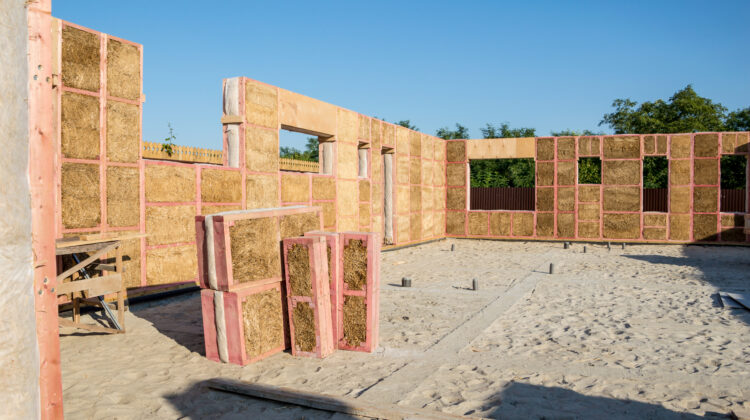
Every summer, fields across Britain produce something the construction industry needs in enormous quantities: material. Around 9.9 million tonnes of straw comes from UK cereal farming each year, and researchers at the University of Bath believe some of it could provide a renewable alternative to more carbon-intensive building materials.
At the moment, that barely happens. Fewer than 20 new homes a year in the UK are built using straw, despite a long history of using the material in buildings. The Bath study suggests the potential is considerably greater.
Researchers looked at where Britain’s straw currently goes and modelled what would happen if some of that supply was redirected into construction. Their conclusion was that there is enough available to support the construction of up to 300,000 low-rise buildings a year, in line with the government’s annual housebuilding ambitions.
Straw is already far from a waste material. It is used for livestock bedding and feed, energy generation and horticulture, while some remains on fields and is incorporated back into the soil. But the researchers found that different combinations of these existing supplies could provide substantial quantities for construction without the country simply running out.
Advertisement

In one scenario, around 60 per cent of the straw currently left in fields would be enough to satisfy the modelled construction demand. Growing additional straw on unused land could provide material for around 163,000 homes, although meeting the full target through that route would require additional supply from elsewhere.
There is another reason for looking more closely at what grows in Britain’s fields. Construction accounts for a significant share of UK carbon emissions, with much of the embodied carbon in buildings coming from materials such as concrete and steel.
Straw behaves very differently. Plants absorb carbon dioxide while growing and, when straw is incorporated into a building rather than burned or allowed to decompose, some of that carbon remains locked within the structure. Bath’s researchers estimate that large-scale use in construction could store between 1.8 and 3.1 million tonnes of carbon dioxide each year for the lifespan of the buildings.
It can also form highly insulated walls and help regulate moisture and indoor conditions. None of that, however, means Britain can simply start replacing conventional walls with bales from the nearest farm.
In fact, that is where the study becomes more interesting from an engineering perspective. The researchers found that the biggest obstacles are not in producing the material, but in creating the system around it.
Advertisement
A construction industry using straw at scale would need reliable links between farmers, processors and building sites. The material would need to be stored, transported and turned into building systems consistently, while more designers and contractors would need experience of working with it. Straw production is also unevenly distributed across the country, making transport and storage part of the equation.
Then there are lenders, insurers and developers, all of whom tend to favour materials and construction methods with established standards, supply chains and performance records. Some straw-building methods are also currently less efficient than conventional construction.
‘Straw is an incredibly common resource here in the UK,’ says lead author Charlotte Taylor, from Bath’s Department of Architecture and Civil Engineering. ‘However, despite being a renewable, low-carbon and historically important building material, very little straw is currently used in construction.’
So the challenge is not really whether Britain has enough straw. According to the study, it does. The harder question is whether the construction industry can develop the supply chains, skills, regulations and confidence needed to turn something already growing in British fields into an ordinary building material.
The research is published in the journal Buildings.