
Four University of East London engineering students have taken joint first place in a national competition that challenges students to solve the sort of structural problems they will encounter in professional practice.
MSc Structural Engineering students Harry Dean, Bishow Simkhada, Siva Prasad Goud Lagusani and Samuel Mensah shared first place in The Concrete Centre’s 2026 Structural Concrete Student Design Competition with a team from Queen’s University Belfast.
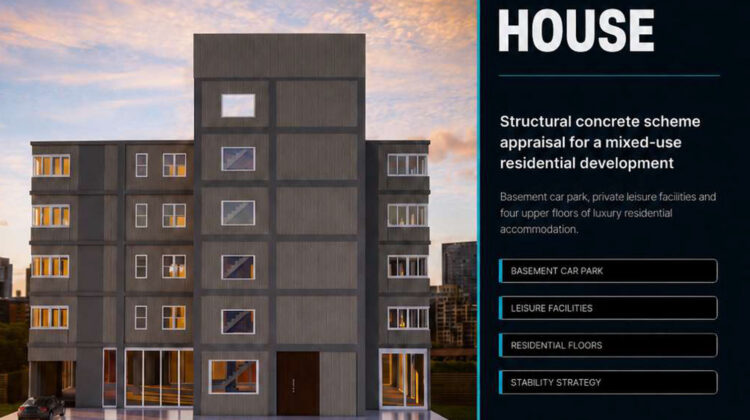
This year’s challenge centred on Portland House, a fictional mixed-use residential development with four floors of accommodation above a ground-floor gym and leisure space, and an underground car park below.
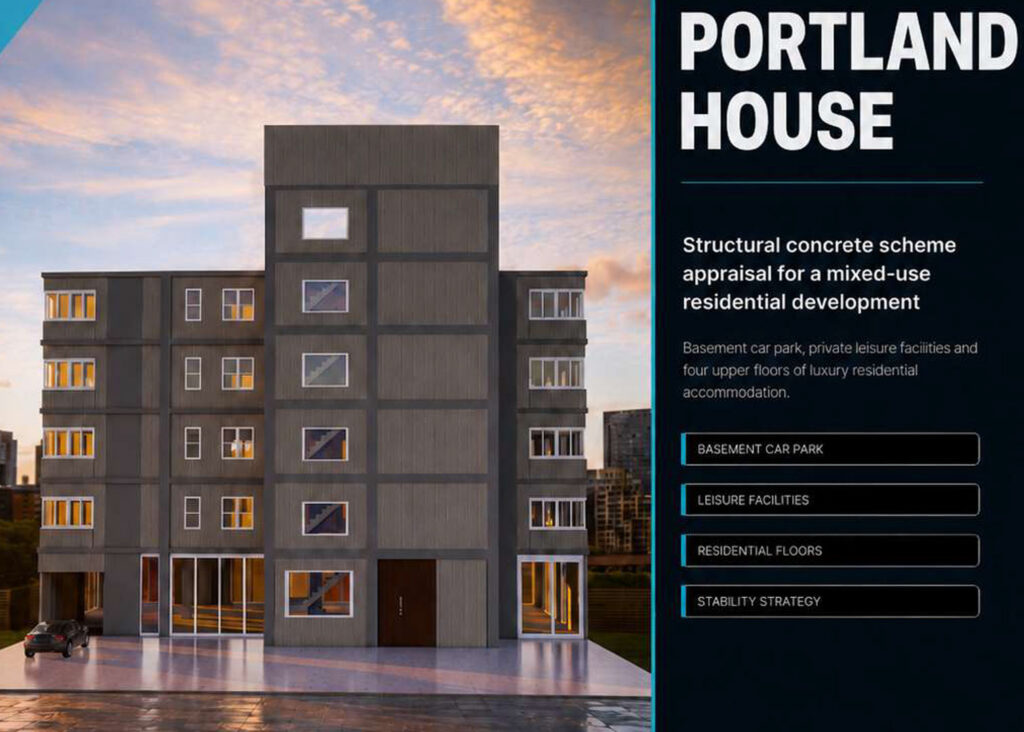
That combination created a familiar structural engineering problem. The column arrangement needed for the residential floors and leisure facilities does not necessarily line up neatly with the open spaces required for parking underneath.
Advertisement

The UEL team developed two possible solutions, one using conventional reinforced concrete and another using post-tensioned concrete. Both incorporated a transfer structure above the car park, allowing loads from the building above to be carried down despite the change in structural arrangement.
Rather than simply producing calculations for one workable design, the students had to compare the alternatives and justify their decisions as though they were part of a professional consulting engineering team. Judges highlighted the quality of their drawings and calculations, as well as their comparison of the two structural approaches.
‘It was particularly rewarding to combine my engineering judgement with the knowledge I’ve developed throughout my MSc and apply both to the project,’ says Dean. ‘To have our design recognised at a national level made all the work we put into the competition feel very worthwhile.’
The result continues a strong run for UEL. The university also took first prize in 2025 after finishing second in each of the previous three years. Since first entering the competition in 2016, its students have secured one of the top prizes eight times in 11 years.
For the students, Portland House offered something difficult to reproduce through lectures alone: a design problem without a single obvious answer. The task was not simply to make the structure stand up, but to weigh different solutions, work around competing requirements and demonstrate why one approach might be preferable to another – much as they will be expected to do when working on real buildings.
Advertisement