
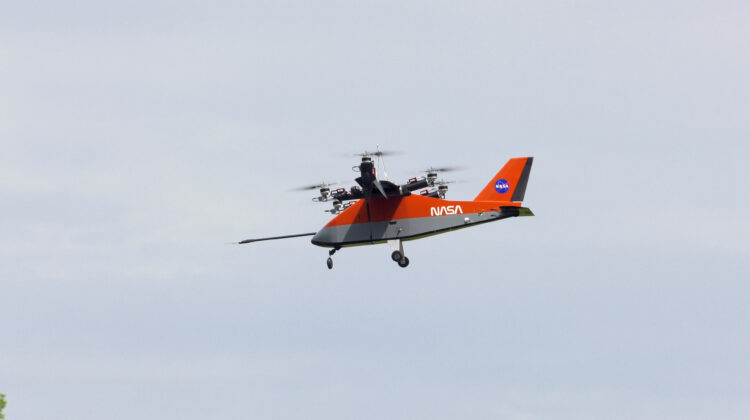
NASA is sharing data from its testing of ‘flying taxis’ in the hope of helping to turn them into a reality.
NASA researchers are using wind tunnel and flight tests to gather data on a scaled-down electric vertical take-off and landing (eVTOL) aircraft and making the results available to aircraft manufacturers so that they can use them for their own designs.
As air taxis take to the skies, engineers need real-world data on air taxi designs to better understand flight dynamics and design better flight control systems. These systems help stabilise and guide the motion of an aircraft while in flight, making sure it flies safely in various conditions.
Currently, most companies developing air taxis keep the information about how their aircraft behaves internal, so NASA is using this small aircraft to produce public, non-proprietary data available to all.
Advertisement

‘NASA’s ability to perform high-risk flight research for increasingly automated and autonomous aircraft is really important,’ said Siena Whiteside, who leads the Research Aircraft for eVTOL Enabling techNologies (RAVEN) project. ‘As we investigate these types of vehicles, we need to be able push the aircraft to its limits and understand what happens when an unforeseen event occurs.NASA is willing to take that risk and publish the data so that everyone can benefit from it.’
By using a smaller version of a full-sized aircraft – dubbed the RAVEN Subscale Wind Tunnel and Flight Test (RAVEN SWFT) vehicle – NASA is able to conduct its tests in a fast and cost-effective manner.
The small aircraft weighs 17 kilograms with a wingspan of almost two metres and has 24 independently moving components. Each component, called a ‘control effector,’ can move during flight to change the aircraft’s motion – making it an ideal aircraft for advanced flight controls and autonomous flight research.
The testing is ongoing at NASA’s Langley Research Center in Hampton, Virginia. Researchers first used the centre’s 3.6-metre Low-Speed Tunnel in 2024 and have since moved on to flight testing the small aircraft, piloting it remotely from the ground. During initial flight tests, the aircraft flew while tied to a tether. Now, the team performs free flights.

Lessons learned from the aircraft’s behaviour in the wind tunnel helped to reduce risks during flight tests. In the wind tunnel, researchers performed tests that closely mirror the motion of real flight.
Advertisement
While the scale aircraft was in motion, researchers collected information about its flight characteristics, greatly accelerating the time from design to flight. The team could also refine the aircraft’s computer control code in real time and upload software changes to it in under five minutes, saving them weeks and increasing the amount of data collected.
NASA developed the custom flight control software for RAVEN SWFT using tools from the company MathWorks. NASA and MathWorks are partners under a Space Act Agreement to accelerate the design and testing of flight control approaches on RAVEN SWFT, which can apply to future novel aircraft.
The work has allowed NASA’s researchers to develop new methods to reduce the time for an aircraft to achieve its first flight and become a finished product. RAVEN SWFT serves as a steppingstone to support the development of a potential larger, 450-kilogram-class RAVEN aircraft that will resemble an air taxi.
This larger RAVEN aircraft is being designed in collaboration with Georgia Institute of Technology and would also serve as an acoustical research tool, helping engineers understand the noise that air taxi-like aircraft create.